

Article content
Each successive generation seems to be sicker with a greater number of illnesses and various disabilities. And that despite the fact that, as authorities claim, nutritional science has improved over the last 50 years.
The reality, however, is far from those claims.
Our grandparents got used to making their own butter, cooking with pork lard, frying, drinking whole milk, and yet they were healthier and slimmer.
How did they manage? First of all, it must be said that they ate less and their food was healthier.
Proportion of fat in the diet and average lifespan
Today we reduce sugar, remove fat from foods, cook less, eat more, consume genetically modified foods, foods with artificial sweeteners, highly processed foods and spend most of our time sitting.
Do you see the difference?
Here is an interesting chart from 1950 that shows on the x-axis the proportion of fats in men’s diets and on the y-axis their average age at death:
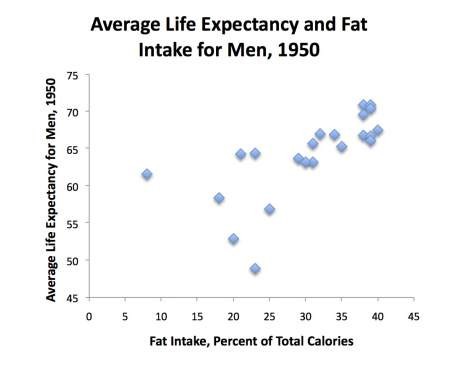
The chart clearly shows that once the share of fats in the diet exceeds 30%, the age of death begins to increase significantly.
Looking at today, fat is being removed from most foods. We have low-fat milk, low-fat yogurts and a number of other foods that boast they are “fat-free”.
Our modern diet has been transformed into low-fat, high-carbohydrate and processed.
As one Australian grandfather with 12 grandchildren says:
“When we were little, there was relatively little food. We ate less than today because there were quite a lot of us at home and we had to share.
There were 7 to 9 children in every family. So there wasn’t much left for us. There were no “Duplo”.
We didn’t overeat, but at the same time we didn’t limit our eating of bread, because otherwise we wouldn’t have enough. But all of that was healthy food. At home we had a large vegetable garden and we even managed to store cauliflower through the winter.”
Science says that calorie restriction can extend life
In his book “In Defense of Food” Michael Pollan, one of the bestselling authors and a contributor to the New York Times Magazine , explains that we could all reduce our calorie intake.
As he states:
“Restricting total calorie intake has been shown to slow aging in animals. It is even believed to be one of the most important factors in cancer prevention.
For example, the people of Okinawa, who are among the longest-living people on Earth, practice the principle ‘Hara Hachi Bu’, which means they eat only until they feel 80% full.”
Various organisms, from yeast to mice to humans, all benefit from calorie restriction. In less complex organisms calorie restriction can extend life two to threefold!
In many studies organisms on a restricted diet die at their natural age without serious diseases. In contrast, up to 94% of animals on a saturated (rich) diet develop some chronic disease such as cancer or heart disease.
According to the results of two previous studies , calorie restriction activates regulatory genes that extend life.
Processed foods as the biggest culprit
The aforementioned Australian grandfather further says:
“We always cooked at home. We ate very little processed food.
When I was young, we had no packaged foods. When my father bought a farm after the war, we milked 2 to 3 cows and made our own butter.”
In his article Six Rules for Eating that appeared in TIME Magazine, Michael Pollan says we should not eat anything that our grandparents would not recognize as food.
“Imagine how lost your grandparents would be in today’s supermarket. Most of the products sold are not foods. They are food-like products,” he says.
History confirms that before you include a new food in your diet you should first wait several decades. The best example is margarines as a substitute for butter.
They previously claimed that margarine would prevent many diseases, mainly cardiovascular ones. Many people, however, questioned these claims. Especially those who valued butter’s millennia-proven beneficial properties for human life.
Today we know that butter is a thousand times healthier for people than margarine. But it took decades before we got there.
My mother always said that one day scientists would find out that butter is much healthier for you than margarine. Today her science is being proven right. Margarines containing trans fats are literally slowly killing us.
Eat foods, not food products!”
Food culture is not what it used to be
Governments here and elsewhere in the world warned the public for years about the risks of a diet high in fats.
Their claims, based on “their science”, concluded that it is good to avoid fat because it contains extra calories. And also that saturated fats increase the risk of heart disease.
This “low-fat mantra” was questioned for years by many doctors and nutrition experts because it has not succeeded in stopping the obesity epidemic. The fact is that a high intake of fats lowers blood sugar, improves lipids and reduces obesity.
In the West over 17,000 new food products are introduced each year, of course supported by strong marketing and advertising. Food corporations try to sell as many of these products as possible while undermining traditional approaches to nutrition.
Moreover, our grandparents did not sit glued to their chairs and couches all evening. They did manual work or rode horses.
They did not know what food allergies were. And they did not deny themselves any healthy food.
Pollan’s 9 principles for healthy eating
1. Eat food. Don’t eat anything your grandparents wouldn’t recognize as food.
2. Avoid food products that claim to be healthy. Don’t forget that margarine was touted as healthy and all it brought people were heart attacks.
3. Especially avoid those products whose ingredients, that is composition, a) you don’t know, b) you can’t pronounce, and c) have more than 5 ingredients . Also those that contain high-fructose corn syrup. None of these characteristics alone is dangerous, but they are a good indicator that the food product is highly processed.
4. Whenever possible, don’t shop in supermarkets. You won’t find high-fructose corn syrup at any local market or farmers’ market. Nor will you find produce harvested long ago and shipped from distant countries. You will usually find fresh produce picked at their peak nutritional quality. Just the kind of foods your grandparents used to eat.
5. Pay more, eat less. You simply cannot avoid the fact that quality food costs more.
6. Eat mostly plant foods , mainly leaves. By consuming plant foods you take in far fewer calories because plants are less calorie-dense.
7. Eat like the French, Japanese, Italians or Greeks. These cuisines are considered relatively healthy and balanced. But this does not apply only to these nations. Essentially the traditional dietary principles of any nation are better than today’s Western style of eating.
8. Cook. If possible, set up a garden. The culture of home cooking contains more wisdom than any scientific journal .Moreover, the foods you grow yourself contribute to your health long before you eat them (think of all the physical activity involved in growing them).
9. Eat like an omnivore. Don’t be afraid to try new dishes and foods. The greater the diversity of your diet, the greater the chance you will meet all your nutritional needs.


