Article content
The topmost layer is formed by columnar cells containing hair‑like structures called cilia. In the middle layer are goblet cells that produce mucus. In the bottom layer of the epithelium there are two layers of basal cells and a thin membrane.
In healthy lungs the epithelial tissue protects the lungs from external influences. Cilia move individual particles in a wave‑like motion back toward the throat.
These particles are coated in mucus produced by goblet cells and mucus glands located deeper. This is how the lungs actually clean themselves. From external impurities (dust, bacteria), but also from tobacco smoke.
Another change observed in smokers’ lungs is an increase in their thickness and mucus production. Because the cilia cannot clear mucus from the lungs as quickly as it forms, it accumulates in the airways, blocks them and causes coughing. The composition of the mucus can also lead to more lung infections, such as chronic bronchitis.
How the lungs heal
Some short‑term inflammatory changes in the lungs can be reversible when people quit smoking, Live Science reports.
In other words, swelling of the lungs and airways subsides and lung cells will produce less mucus. The cilia will be more effective at removing mucus from smoke‑exposed lungs.
After just a few days and weeks, smokers may notice they breathe better. One possible reason for the reduction in shortness of breath is that carbon monoxide has left the blood.
This gas, found in cigarette smoke, can affect oxygen transport in the body, because carbon monoxide binds to red blood cells instead of oxygen. This can cause shortness of breath in some smokers.
Changes
Former smokers may paradoxically cough more and more forcefully during the first weeks of abstinence than when they were smoking. However, this is progressive. It means that the pulmonary cilia are active again and the fine hairs can now move excess mucus secretions from the lungs into the airways and toward the throat. The cough thus cleans the lungs.
Another benefit of quitting smoking is also a reduced risk of lung cancer. The longer former smokers remain abstinent, the more the risk decreases.
However, it can never disappear entirely. After ten years of smoking abstinence the likelihood of developing lung cancer falls by more than half.
Not all changes are reversible
The human body is very effective in the lungs’ recovery process in former smokers, but not all damage is reversible.
Lung damage and deterioration of lung function are directly related to the number of cigarettes a person typically smoked per day over a number of years.
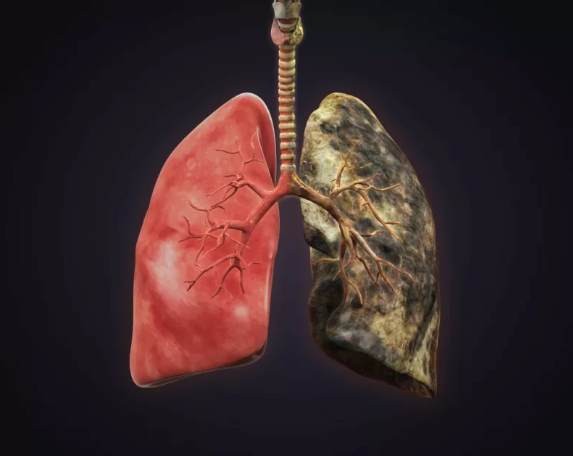
Although the lungs have their own mechanisms to protect against damage, with long‑term exposure to harmful substances inhaled from cigarettes these defenses diminish. Pulmonary tissue can eventually become so inflamed and scarred from smoking that the lungs lose elasticity and can no longer effectively exchange oxygen.
Long‑term smoking can lead to emphysema, a type of chronic obstructive pulmonary disease (COPD). This condition destroys parts of the lungs known as alveoli, where the exchange of oxygen and carbon dioxide takes place. People with COPD suffer from shortness of breath and difficulty breathing.
When the lungs are damaged to the point of emphysema, the walls of the airways lose their shape and elasticity, which makes it difficult to expel all the air from the lungs. These lung changes are permanent and irreversible.
MRI imaging recently showed that airway damage associated with emphysema begins several years after a person starts smoking, although the symptoms of the disease may not appear until 20 or 30 years later.
If you now feel like having a cigarette, you’d better think twice.