Article content
With rising food prices and the relentless use of pesticides and other chemical sprays, healthy fruit and vegetables are quickly becoming a luxury.
Only those willing to pay extra for organic crops, where the use of chemical sprays is either completely banned or strictly regulated in terms of quantity and type, can afford them.
Although most chemicals from crops are washed off over time by rain after spraying, significant residues remain in them.
Added to that are sprays applied to already harvested fruit and vegetables to extend their freshness during transport, sometimes across continents.
What pesticides can do to your health
Once pesticides enter your body, they can lead to the development of various serious acute and chronic diseases – from eczema at the mild end to cancer at the severe end.
Removing them from your fruit and vegetables is therefore the first step on your path to better health.
As consumers we usually have no influence over what is sprayed on our food at farms and during transport.
Fortunately, there are a few quick methods to get rid of most pesticides.
The national institute for nutrition recently issued general recommendations that contain simple steps households should adopt when removing pesticides from fruit and vegetables.
Step 1
About 75 to 80% of pesticides on fruit are removed after a simple rinse in cold or, even better, lukewarm water.
This concerns surface pesticides on fruits such as grapes, apples, plums, peaches or pears and also vegetables like tomatoes or peppers.
It usually requires 2 to 3 rinses.
Step 2
The next step in removing pesticides is soaking them in saline water.
A 2% solution of salt and water usually flushes out most of the pesticides that are located on their surface.
Especially for leafy greens, it is necessary to rinse them thoroughly several times.
Step 3
The final step is thorough cleaning to remove all pesticides that are not only on the surface but have often penetrated deeper into the peel or rind of fruit and vegetables.
For this purpose it is appropriate to use a solution of water and vinegar in a ratio of 1 part vinegar to 4 parts water.
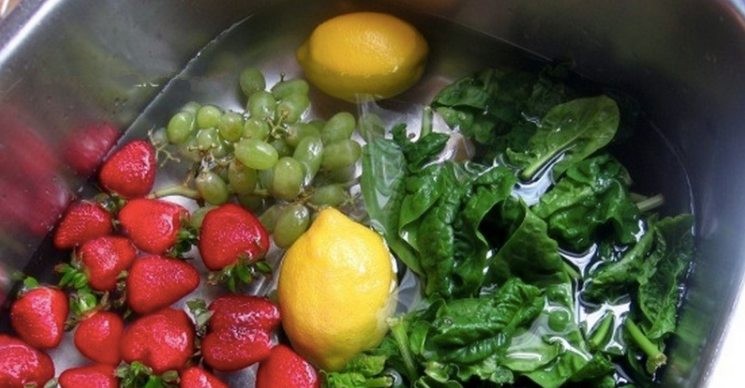
Take a large bowl and fill it with the stated solution. You can also use a kitchen sink for this purpose (of course cleaned).
Immerse your fruit and vegetables in it and let them stand for at least 1 hour. Then rinse them again under running water and they will now be ready to eat!
Conclusion
Finally, notice what has been released into the solution during that hour. You will be surprised how much dirt you find in it.
Such washing of fruit and vegetables, besides removing pesticides, has one more excellent property – it significantly extends the time during which they will not spoil or rot.