Article content
Two people enter a health clinic. One is an older, 72-year-old man. He is tall, thin, naturally fair-skinned, often has cold hands and feet, has scattered thoughts at night and suffers from insomnia.
He tends to have dry skin and has always had thin, fine hair; his digestion is usually very sensitive. Today he came to the doctor with an itchy, red skin rash.
The other person is a woman in her early forties. Her build could be described as medium or athletic, she tends to have oilier skin, a strong appetite, is temperamental and often hungry.
She also came to the doctor today with a red and itchy rash.
The difference between “modern” and traditional medicine
At a modern Western medical clinic the doctor would diagnose both as eczema and prescribe the same steroid-based ointment to both patients — a solution that does not address the cause but causes the rash to subside. At least temporarily.
Those of us who live in the West, or in the modern world in general, know such stories well. But might there be more to these patients’ stories and why their symptoms can manifest like this?
The ancient Indian system of healing and health called Ayurveda would view the cases of these two patients with a level of attention, thoroughness and complexity that the medical mindset we encounter in the Western world is unfamiliar with.
Ayurveda focused intensively on the energetic and constitutional states of patients, which brings with it a deep and organized understanding of the phases of disease.
How imbalance begins, continues, and how and why these processes are uniquely shaped by an individual’s constitution, rather than taking the one-drug-fits-all approach.
Knowledge is key in Ayurveda. This system served whole human communities and continues to help people today in finding understanding and reversing the disease process.
Let’s look at it more closely:
The essence of Ayurvedic medicine
The word Ayurveda comes from Sanskrit and means “the science of life”. It is one of the oldest healing systems in the world, originating more than 5,000 years ago.
The focus in this system is on maintaining balance in the human body by observing the energies that allow health to develop and be sustained.
It also provides ways to regain that balance and inner grace when systems are not functioning properly.
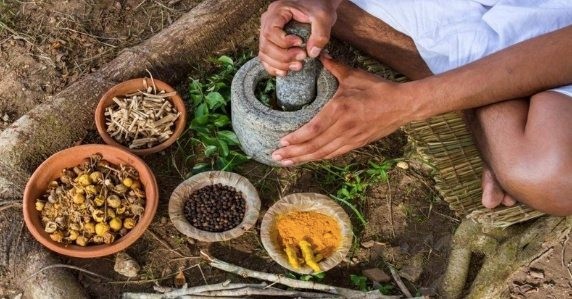
Health is achieved through supportive methods such as diet, exercise, daily routines, cleansing, medicinal herbs, emotional health and other natural therapies, for example massage.
To understand the essence of Ayurveda we examine the concept of DOSHA. In this system every individual can discover their DOSHA or combination of DOSHAS: the unique constitutional factor determined by a specific combination of five elements that are naturally present in a person.
The five known elements are air, earth, water, fire and ether. A characteristic combination of two neighboring elements forms each of the three main DOSHAS: vata, pitta and kapha.
6 phases of disease according to Ayurvedic medicine
1. Vata – combines air and ether with energies presenting as dry, light, clear, mobile and cold.
2. Pitta – combines fire and water, presenting its nature as oily, hot, spreading and fluid.
3. Kapha – combines earth and water and is expressed as heavy, slow, dense and stable.
Each person can, through various assessment methods, determine their DOSHA and it may be one of these, though often it is a combination of two DOSHAS.
These doshas also mainly define energetic states existing in nature and in all things. From the Ayurvedic perspective these three doshas enliven processes of health and also disease, and how disease manifests and progresses.
Six Ayurvedic phases of disease
The identification of “symptoms” is tuned very finely and sensitively.
As contributing factors that can disturb homeostasis and open a person’s body to the disease process, mood swings, digestive patterns, changes in diet and lifestyle, etc. are taken into account.
Ayurveda recognizes six phases of disease which, if the initial signs do not receive proper attention and care, progress one into another. These phases are:
- accumulation
- aggravation
- spread
- localization
- manifestation
- differentiation, or destruction.
Understanding each could not only tell us why the older gentleman and the younger female patient we mentioned earlier, despite showing similar symptoms, may be experiencing entirely different disease processes, but focusing on important details can also provide insight into our healthcare.
1st phase: Accumulation (Sanchaya)
In the first phase one of the doshic energies ceases to be in balance, and that may or may not be one of the individual’s constitutional energies. Toxins, bacteria, parasites or other destructive elements begin to accumulate in the body.
All doshic imbalances begin in the digestive tract. Vata imbalances begin in the large intestine, pitta imbalances in the small intestine and kapha imbalances in the stomach. In this phase symptoms are mild and easily addressed.
Vata may experience symptoms such as gas, bloating, cold flashes, constipation or anxiety and insomnia.
A pitta imbalance can be translated as excess stomach acid, overheating, irritability, a bitter taste in the mouth and loose, foul-smelling stools.
With a kapha imbalance you may notice symptoms such as slow digestion, lethargy, pallor and a feeling of heaviness in the limbs or head.
2nd phase: Aggravation (Prakopa)
When mild symptoms are ignored and not addressed (as many of us tend to do!), the problem grows and more serious symptoms may begin to appear — though still in the gastrointestinal tract. At this point the symptoms can still be resolved relatively easily.
In this phase vata symptoms present as body stiffness, tingling in the hands or feet, facial tension, sensitivity to sounds, intolerance of cold food and appearing and disappearing muscle pain.
Pitta symptoms now appear as a sour taste in the mouth, increased thirst, anger, burning during urination and craving for alcohol.
Symptoms of increased kapha include: loss of appetite, sticky skin, mental fog, excessive sleep, a white coating on the tongue and a feeling of heaviness.
When the imbalance process reaches this phase, it is wise to act, because moving into the third phase will require more effort and possibly a series of professional healthcare interventions.
3rd Phase: Spread (Prasara)
If symptoms up to this point were ignored or unsuccessfully treated, the disease process can begin to spread.
Although it is still possible in this phase to redirect the process, it begins to spread outside the gastrointestinal tract. In this phase tastes and reactions to foods may change.
Vata symptoms tend to spread to the skin, bones, ears, respiratory tract, thighs and pelvic area.
Pitta symptoms may progress to the eyes, liver, brain, plasma, blood, heart and spleen.
Kapha symptoms can spread to the lungs, joints, sinuses, pancreas and tongue.
4th phase: Localization (Sthana Samshraya)
As the disease progresses from the third to the fourth phase, all doshas respond to the disease process similarly, or the imbalance seeks out a weak spot in the body and localizes there.
This weak spot is called khavaigunya, or the “defective space”. When disease localizes, it begins to disrupt cellular function, creating more serious problems.
If the cells are healthy enough that they are not affected, the condition reverses and returns to the gastrointestinal tract. If cellular function is disturbed, the localized disease becomes more apparent.
5th phase: Manifestation (Vyakti)
In the manifestation phase the swollen localized site is apparent and often requires urgent medical attention.
A diagnosis within Western medicine is usually made at this phase, not earlier. The disease now begins to affect additional organs as well.
6th phase: Differentiation, or destruction (Bheda)
When the disease has not been treated effectively, it now begins to destroy tissue and cause serious damage.
When a disease reaches this phase, treating it is extremely difficult.
Awareness, sensitivity, health well-being
True practitioners of Ayurvedic medicine can spend a lifetime mastering the finer details of diagnosis, treatment and procedures in this complex but intuitive system of medicine, and working with a specialist is always recommended.
Simply examining the concepts of this “science of life”, or knowing our doshas, can provide sufficient insight into our natural constitution and start an inner dialogue.
Staying healthy or regaining well-being after we’ve been out of balance for a while could be as simple as becoming aware of what doesn’t feel quite right, or in which areas we don’t feel like ourselves.
As in the story of the two patients we glanced at at the beginning, each of us is a unique combination of elements and energies.
And although it is possible to simply assign a universally valid diagnosis to any condition, Ayurveda with its sensitive and in-depth examination of the disease process can offer a different, more individualized approach to living in a state of well-being.