
Article content
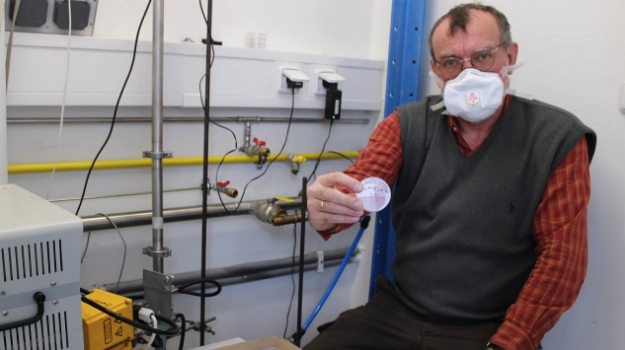
A two-story measuring apparatus in the Department of Chemistry and Physics of Aerosols within the Institute of Chemical Processes of the Czech Academy of Sciences has been running almost without interruption for a week.
The largely emptied workplace, in whose laboratories only five employees remain out of twenty-five because of the nationwide quarantine, is now trying to answer a pressing question. Which nanofiber fabric captures the maximum amount of the tiny coronavirus measuring 80 to 150 nanometers? If nanofibers could be arranged efficiently, such a mask might match the functionality of the best respirators. The department led by chemist Vladimír Ždímal is now collaborating with the Czech Technical University in Prague and the Technical University of Liberec.
One of them is working on a new respirator for repeated use and the other on producing nanofiber material that would serve in them as a filter to capture particles as small as viruses.
“You cannot generally say that nanofiber materials are better. It very much depends on their structure,” Ždímal says. For comparison, his workplace also tested several substances commonly available at home. “I sacrificed a working cotton T-shirt, a silk handkerchief and also a scarf. My wife wasn’t too happy about that,” he points to the torn fabrics. Large circular cutouts from them were placed into their device and an aerosol with salt particles that mimicked the size of the virus was passed through them for several hours.
In measurements they confirmed that when it comes to protecting others, practically any covering of the mouth and nose works. At such a short distance the droplets are still large enough to be captured by an ordinary cotton mask. “In this case the droplets are roughly from 0.1 to 1 millimeter and the mask’s capture efficiency is close to 100 percent,” the head of the workplace reports.
With uncovered mouths the freely flying millimeter droplets evaporate very quickly, within a distance of half to one meter. Beyond that, only the viruses themselves, sized 80 to 150 nanometers, continue flying. Therefore, masks do not work well as protection from viruses in the environment. One layer of cotton fabric in such a case captures about 11 percent of viruses. “But that corresponds to the inhalation of a heavily working person. Protection can be significantly increased by reducing the breathing rate,” Ždímal adds.
In their measurements the scarf performed best, capturing nearly twenty percent of the viruses. In laboratory conditions they did not, however, address for example the mask’s ability to adhere to the face, the structure of the materials or their moisture, which is also crucial for their functionality. “As soon as a classic mask gets wet, it becomes permeable and unprotective. And that happens after about twenty minutes,” said Jiří Beneš, an infectious disease specialist at Bulovka Hospital, to DVTV. Ždímal confirms this. “However, the droplets will be smaller and evaporate faster, so even such a mask has some significance for protecting others,” Ždímal believes.
Viruses trapped in droplets in the mask generally remain in it. Exhalation through the mask should not release them into the surroundings. According to Ždímal this is caused by adhesion forces, which are much greater than the force of air during exhalation.
In the past the institute also evaluated respirators. Even those do not provide one hundred percent protection from surrounding viruses. “The best ones let through around 0.3 percent of viruses, and that’s under laboratory conditions where they are perfectly sealed. But on the face you will always have some leakage. Even a gap with a diameter of a tenth of a millimeter is for a virus like a hole the size of an entire Prague city district,” Ždímal warns. Moreover, the virus perfectly follows airflow streamlines, so it does not have to navigate any complicated turns.
Therefore, healthcare workers with respirators are not absolutely protected either, and during long stays in an infected environment they can become infected as well.
On the other hand, when the virus penetrates in small doses, the immune system usually manages to cope with it.
“Only professional gas masks are more effective than respirators. Those—if well sealed—may let through only one virus out of ten million,” Ždímal says.


