
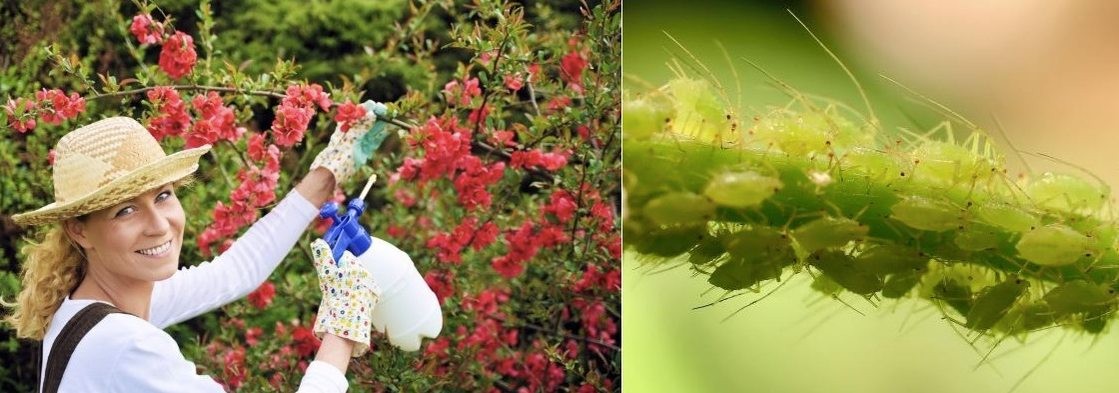
Article content
Aphids are among the most widespread garden pests. They live in colonies and attack not only ornamental but also edible plants. They reproduce very quickly and are literally a nightmare for every gardener.
The presence of aphids is indicated primarily by a high number of ants.
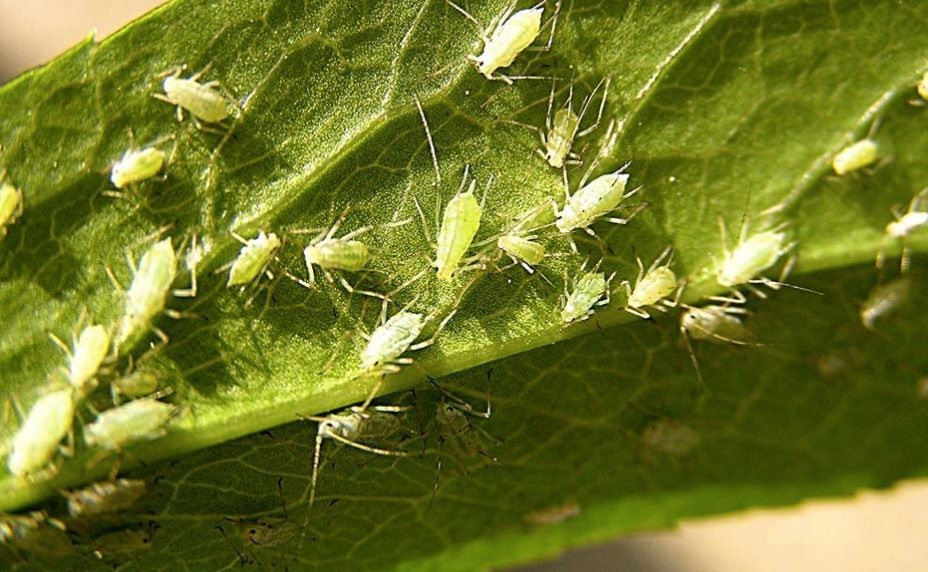
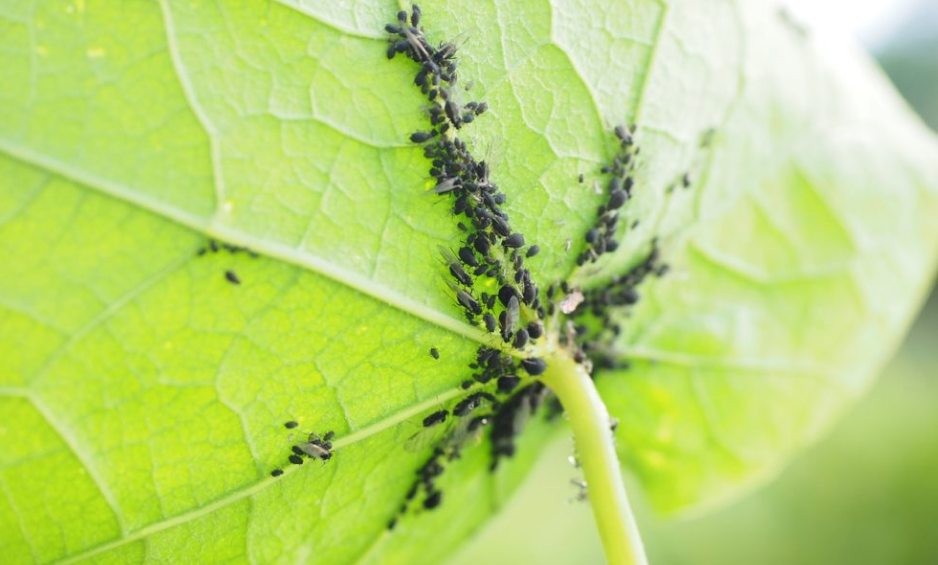
This is because ants can serve as a means of transport to spread them, and ants also seek out their secretions, known as honeydew. Aphids overwinter as eggs that hatch in spring. They can have various colors, for example green, yellow, pink, light brown, black, gray, etc. They can have slender or more robust bodies. If they attack a plant, they suck its sap, which quickly shows on its appearance. Such plants lag in growth; the leaves are deformed, change color, turn yellow and fall off.
Without chemicals
You can easily deal with this problem even without chemical spraying.
Experienced gardeners have found that non-toxic mouse glue works best. For example, smear the base of the trunk so the pests stick to it. According to experience, it is said to be more effective than protective tree glue or adhesive bands and you don’t have to worry that it would damage the tree bark. Already after the first day you will be able to see how many pests have stuck to it. Grafting wax is said to help just as well.
The natural enemies of aphids are seven-spot ladybirds, which readily feast on aphids and are therefore welcome helpers in the garden. However, chemical spraying does not only eliminate unwanted pests but also such natural helpers. Therefore it is much better to use biological agents to protect crops. When choosing them, make sure above all that they are effective only against sap-sucking and chewing pests so they do not harm their natural predators.
You can also use mechanical protection and during the growing season cut off infested leaves and shoots.
What has proven useful to gardeners
Although it is still fairly early for an aphid invasion in our gardens, it is better to prepare earlier than be unpleasantly surprised. We have collected for you 21 of the best home recipes from Slovak growers that they use to fight aphids, whiteflies and mites. Save it and don’t lose it — it will certainly come in handy!
1. Vodka: The cheapest method is to pour vodka into a sprayer and spray the infested areas.
2. Coca-Cola: Works the same as vodka; just pour and spray.
3. Lye soap: Dissolve 200 g in 10 liters of water and use as a spray.
4. Ammonia: Dissolve 1 tablespoon in 10 liters of water, use as a spray.
5. Baking soda: Dissolve 1 tablespoon in 1 liter of water and add 40 g of grated lye soap. Use as a spray.
6. Wood ash
Pour about 200–300 g over 5 liters of boiling water, let cool, add 20 g of grated soap and use as a spray.
7. Horseradish infusion: Fill a bucket halfway with horseradish leaves and roots, add water and let stand 2–3 hours. Apply the liquid to the affected areas as a solution.
8. Hot decoction from green bean pods: Chop 1 kg of green bean pods and boil for 1 hour in 10 liters of water with the lid on. Let the decoction stand for 2 days, strain it, pour into bottles, seal with a cork stopper and you can store it in a dark place for years. For treating smaller plants and shrubs use ½ cup dissolved in 10 l of water. For treating trees double the dose. It is advisable to add 40 g of grated soap to the decoction.
9. Celandine: Pour 10 l of water over 3–4 kg of fresh (or 1 kg of dried) herb and let steep 1–2 days. Then strain and use as a spray.
10. Pine infusion: Put 2 kg of young shoots into a bucket, fill with water to the top and let stand for a week. Stir daily. Use as a spray.
11. Nettle infusion: Most effective on plants that are young and have not yet produced flowers. Make the infusion from 1 kg of torn fresh nettles and 10 l of water — preferably rainwater. Let steep for 1 day and then strain (don’t forget to wring the nettles well; that’s where the most active substances are). Apply to the affected plants.
12. Tansy infusion: Best for protecting strawberries, raspberries, blackberries and, besides aphids, it also fights codling/tortrix moths. For the infusion you need 40 g of dried tansy flowers and 1 l of boiling water. Pour over the flowers and let steep 15–20 minutes. Strain, wring the flowers again and when the liquid cools, apply to the plants as a spray.
13. Dandelion infusion: Pour 10 l of water over 400–500 g of leaves and let steep for 2–3 hours. Strain and use as a spray.
14. Garlic infusion: To obtain 1 l of infusion you need 25 cloves and 1 liter of boiling water. Chop or grate the cloves and pour the water over them. Let steep for 10–15 minutes, strain and apply to the affected plants.
15. Potato leaf infusion: Pour 5 liters of boiling water over 300 g of green leaves, let stand for a day and use, adding 20 g of grated and dissolved soap.
16. Mustard spray
Dissolve 200 g of mustard powder in a bucket of water.
17. Tobacco powder: Pour 1 kg of tobacco dust into 10 l of water (60 degrees Celsius). Let steep for a day, then strain. Dilute 2 liters of the solution in a bucket of water and use on affected plants.
18. Orange peel: Pour 10 l of water over 1 kg of peels and let steep for at least 3 days.
19. Sorrel: Pour 10 l of water over 300 g of finely chopped sorrel roots and let steep for 3 hours.
20. Chamomile: Pour 10 l of warm water over 1 kg of dried chamomile (flowers, leaves and stems). Let steep for 12 hours.
21. Burdock infusion: Crush a bucket of burdock leaves (using a stick to release the juice) and pour over 5 liters of warm water. Let steep for 2 days.


