Article content
Recently the debate about colorectal cancer has revived.
The International Agency for Research on Cancer (International Agency for Research on Cancer (IARC)), which is part of the World Health Organization (World Health Organization (WHO)), concluded at the end of 2015 that processed meat may be a cause of colorectal cancer in humans.
IARC thus classified processed meat in Group 1 of carcinogens.
Colorectal cancer is the third most commonly diagnosed cancer in the United States (skin cancer not included).
It is estimated that in 2016 more than 95,000 new cases of colon cancer (and more than 39,000 cases of rectal cancer) will be diagnosed.
Our large intestine plays an extraordinarily important role in maintaining health. Food passes through the digestive tract including the large intestine, where it is deprived of fluids and salts, and is then eliminated by the body.
Besides producing, storing and excreting waste products, the large intestine also contains billions of bacteria whose health and balance are essential for our well-being.
Many causes of colorectal cancer can be prevented
Colorectal cancer is the second leading cause of cancer-related deaths in the United States.
However, as with most cancer types, colorectal cancer can be prevented in many cases.
Research published in the journal Pharmaceutical Research estimates that only 5 to 10 percent of cancer causes originate from genetic disorders.
The remaining, disproportionately larger part, however, originates in negative environmental influences and an unhealthy lifestyle.2
Scientists estimate that about 35 percent of cancer deaths originate from diet, another 30 percent from tobacco products, 20 percent from infections, and the rest from environmental influences such as various radiations, stress, amount of physical exertion and environmental pollution.
The American Institute for Cancer Research (American Institute for Cancer Research (AICR)) also stated that about one third of cancer cases in the United States can be prevented through a healthy diet, regular physical activity and maintaining a healthy body weight.
In the case of colorectal cancer, the rate of possible prevention through a healthy lifestyle rose to as much as 50 percent.3
Top recommendations for preventing colorectal cancer
You may begin today to make healthy changes in your life that will reduce the risk of this potentially deadly disease. The top recommendations include the following:
1. Eat more vegetables and some fruit
Vegetables contain a variety of antioxidants and other disease-fighting components that are difficult to obtain from other foods. For example, we can mention magnesium.
Results from one meta-analysis show that every 100 mg increase in magnesium intake reduced the risk of colon and rectal tumors by 13 percent, and the risk of colon and rectal cancer decreased by 12 percent.4
Scientists believe that the anticancer effect of magnesium may be related to its ability to reduce insulin resistance, thereby acting against tumor formation.
In addition to magnesium, chemical compounds in plants known as phytochemicals have the ability to reduce inflammation and neutralize carcinogens.
Other compounds regulate the rate of cell division, rid the body of old cells and repair damaged DNA.
Vegetables are also one of the best sources of fiber. Research repeatedly shows that people with higher vegetable intake have fewer cancer cases.
Vegetables from the cruciferous family are particularly beneficial due to their sulforaphane content. Sulforaphane is a naturally occurring sulfur compound in vegetables. It has been found, for example, to act against the development of colon tumors.6
If we are healthy, it is also beneficial to consume a moderate amount of fruit. According to one study, consuming dried plums can reduce the risk of colorectal cancer by promoting the growth of intestinal bacteria.7
2. Eat more fiber
It is proven that dietary fiber reduces the risk of colon and rectal cancer, especially adenomas of the colon and rectum and distal colon cancer.8
Moreover, every 10 grams of fiber we add to our diet reduces the risk of colorectal cancer by 10 percent.9
A 2005 study also confirmed that dried plums “favorably modified … risk factors for colon cancer” in rats, probably due to their high content of dietary fiber and polyphenols.10
If you already follow the tip above and eat more vegetables, you are doing the right thing because you are naturally getting more fiber from one of the best sources – vegetables.
Psyllium seeds, flaxseeds, hemp seeds and chia seeds are also rich sources of soluble and insoluble fiber.
3. Optimize your vitamin D intake
Vitamin D deficiency is one of the risk factors for colorectal cancer. According to a study published in the journal Gut, people with higher vitamin D blood levels were less susceptible to colon and rectal tumors.11
The reason may be that vitamin D benefits our immunity and that can in turn act against the development of cancers. According to researchers: 12
“Evidence suggests that vitamin D has protective effects and strengthens immunity against tumor development and colorectal cancer.
Immune system cells in the tumor microenvironment have the ability to convert 25-hydroxyvitamin D [25 (OH) D] [vitamin D] to the bioactive 1a,25-dihydroxyvitamin D3, which acts on neoplastic cells and immune system cells.
High plasma levels of 25 (OH) D reduce the risk of colorectal cancer through a strong immune response of the organism.
The role of vitamin D is therefore to support the immune system, thereby preventing tumor development through interactions between the tumor and the host.”
Regular sun exposure, the use of high-quality tanning beds and/or taking dietary supplements of vitamin D3 can help us reach an optimal vitamin D level in the range of 50 to 70 ng/ml.
It is recommended that we regularly check our vitamin levels so we can be sure we are within that range.
4. Avoid consuming processed meat
Processed meat is meat that is preserved by smoking, drying, salting or adding preservatives.
Processed types of meat include bacon, ham, pastrami, salami, paprika salami, hot dogs, some kinds of sausages, meat patties (if preserved with salt or chemical preservatives) and others.
Nitrates (nitrites) in meat are particularly harmful. They are added to meat as a preservative ingredient, which also gives the meat color and flavor.
Nitrates found in processed meat often turn into nitrosamines. It is clearly proven that nitrosamines are associated with an increased risk of certain types of cancer.
The American Institute for Cancer Research (AICR) warns that “there is no safe amount” of processed meat consumed.13
5. Find out all available information about red meat consumption
Studies point out that people who consume the most red meat (in one study that was 150 g of meat per day) have a 24 percent higher risk of colorectal cancer compared to those who eat the least red meat.14
Red meat itself is probably not the problem. The more important role is how the meat is prepared as well as the source from which it originates.
For example, red meat from grass-fed cattle contains anticancer chemical compounds.
On the other hand, glyphosate, the active ingredient in the herbicide Roundup, is known to potentially have harmful effects on gut bacteria and is also considered carcinogenic.
Animals in industrial factory farms are usually fed grain contaminated with glyphosate.
Cooking and roasting red meat at high temperatures (e.g., grilling or frying) can also produce carcinogenic substances as by-products, such as heterocyclic amines (HA) and polycyclic aromatic hydrocarbons (PAHs).
I therefore recommend consuming only meat from free-range sources. Cook or roast it only lightly (for example, a steak should be only lightly seared, i.e. “rare” and not thoroughly cooked or “well done”).
I believe that most people need animal proteins for their health, but most consume far more protein than is necessary (and healthy).
6. Exercise
There is reliable evidence that regular exercise can significantly reduce the risk of colon cancer.15
According to one study, physically active men and women have a 30 to 40 percent lower risk of colon cancer compared to inactive people.16
Exercise leads to reduced insulin levels and regulating insulin levels in the blood is one of the best ways to lower cancer risk.
It is also thought that exercise triggers apoptosis (programmed cell death), which leads to the elimination of cancer cells.
In addition, exercise improves circulation of immune system cells in the blood. The role of these cells is to neutralize the action of pathogens (microorganisms) in the human body, as well as to destroy precancerous cells before they become cancerous.
The better the circulation and transport of immune system cells in the body, the more effective the immune system will be in fighting infections and diseases, including cancer.
7. Maintain a healthy body weight and healthy body fat percentage
Many studies repeatedly find a link between obesity and an increased risk of several different types of cancer, including colorectal cancer.
A 2014 study that processed data from more than 5 million people older than 16 concluded that every 5 kg increase in body weight leads to a greater risk of developing 10 different types of cancer.17
If you suffer from overweight or obesity, even a small reduction in your body weight can have significantly beneficial effects on your health.
From the perspective of cancer prevention, it is particularly important to get rid of as much excess body fat as possible. Increased body fat percentage is associated with a higher risk of colorectal cancer, regardless of your body weight.
8. Limit alcohol consumption and quit smoking
Excessive alcohol consumption, as well as smoking, are associated with an increased risk of colorectal cancer.
As for alcohol, I generally define “moderate” consumption after a meal (permitted in the beginner phase of my nutrition plan) as 150 ml of wine, 360 ml of beer or 30 ml of hard liquor per day.
When you are more advanced in my nutrition plan, I recommend stopping alcohol consumption entirely.
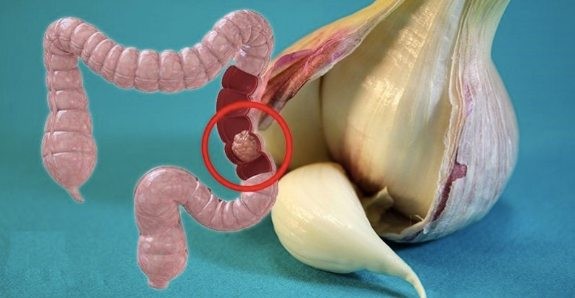
9. Eat garlic
Laboratory studies have shown that garlic has a destructive effect on cancer cells. These studies also confirm promising anticancer effects of garlic when included in our diet.
According to another study of women who regularly consumed garlic (along with fruit and vegetables), the risk of colorectal cancer was 35 percent lower.18
Women who consume substantial amounts of raw garlic have been shown to have a lower risk of stomach cancer as well as colon and rectal cancer.19
In addition, in people with inoperable tumors of the colon, rectum, liver and pancreas who took garlic extract for six months, immune system function improved significantly.
This suggests that consuming garlic may be beneficial for strengthening immunity during times of stress or illness.20
If we include raw garlic in our diet, it is best to crush or finely chop the cloves to allow better release of the enzyme known as alliinase.
Alliinase then helps form allicin.
Allicin quickly breaks down into a variety of different organic sulfur compounds. If we want to “activate” garlic’s medicinal effects, it is recommended to crush a fresh clove with a spoon or finely chop it before swallowing and add it to a salad or put it into a juicer with vegetables when making vegetable juice.
Should we start regular colonoscopy screenings after turning fifty?
Men and women aged 50 and over with only average risk of colorectal cancer are commonly advised to have a flexible sigmoidoscopy every five years or a colonoscopy every ten years.
But are these tests safe and really necessary? I am over 60 and I have never had a colonoscopy and I do not intend to have one.
These examinations are undoubtedly effective diagnostic methods, but I am convinced that with my way of eating (my diet includes a certain amount of fresh turmeric daily) and lifestyle it is very unlikely that I would develop colorectal cancer.
However, for many people who are at higher risk of cancer, colonoscopy can be an effective preventive method.
Colorectal cancer develops very slowly and is also one of the most common cancers that end in death. Therefore it is very important to detect it as early as possible.
One option is to do an annual fecal occult blood test. However the drawback of this test is that it is often inaccurate and will yield a positive result.
Recent evidence confirms that the fecal occult blood test is not entirely reliable.
Another option is to undergo a flexible sigmoidoscopy every five years. The examination is similar to a colonoscopy but uses a shorter and smaller endoscope, so it cannot examine the more distant parts of the colon.
On the other hand, sigmoidoscopy does not lead to as many complications. Ultrasound examination has also proven effective.
Generally, examination with optical instruments is the most reliable way to detect possible colorectal cancer early.
It is the colonoscopy that allows our doctor to find out the condition of our colon.
If polyps found in the intestine are still in their initial stages, the doctor can simply remove them immediately. Thus colonoscopy is not only an examination, but a surgical procedure can also be performed during it.
Using colonoscopy, a photograph of the polyp is first taken, the polyp is then cut off, removed and finally sent for biopsy.
A colonoscopy can save your life, it is certainly worth considering. However, be aware of the other side of the coin, namely that statistically 1 in 350 colonoscopies results in serious injury inside the colon.
In 1 in 1000 procedures death occurs.
In addition, 80 percent of endoscopes are cleaned after the procedure with a Cidex solution (glutaraldehyde), which, however, does not sterilize the used endoscope perfectly without flaw.
This creates the possibility of transmitting material that could easily cause an infection. Therefore, before an endoscopic examination it is important to ask what solution was used to clean it.
It could save your life. Make sure the endoscope was sterilized with peracetic acid – this eliminates the possibility of transmitting infectious agents from previous patients.
15 simple recommendations for cancer prevention
Cancer usually does not arise overnight. That means we primarily have the opportunity to make changes in our lives that could potentially prevent cancer.
Most of us carry microscopic clusters of cancer cells within us all the time.
The reason why not every one of us (fortunately) reaches the stage of cancer is that if our body has the ability to regulate the process of angiogenesis, it prevents excessive formation of blood vessels that would nourish these microscopic tumors.
The problem arises when cancer cells succeed in creating their own blood supply – at that moment harmless cells turn deadly.
There are many ways we can reduce the risk of cancer; some of them are listed below: 21
1. Avoid drinking sugary beverages, such as sodas, and avoid consumption of industrially processed sugar as much as possible.
2. Try to sit as little as possible and move more; we should aim to take 10,000 steps daily.
3. Drink green tea, which is a rich source of epigallocatechin-3-gallate (EGCG). EGCG is a catechin polyphenol with anticancer effects.
4. Steam your broccoli. Broccoli prepared this way contains more glucosinolates (which have anticancer effects) than boiled, fried or microwaved broccoli.
5. Include a few Brazil nuts in your diet. These nuts have a high selenium content, which is a mineral extremely beneficial for reducing the risk of prostate cancer, colorectal cancer and lung cancer.
6. Include artichokes in your diet. They contain silymarin, an antioxidant that may reduce the risk of skin cancer.
7. Spend time regularly outdoors in the sun. Sun exposure optimizes vitamin D levels in our blood, which is a key factor in reducing cancer risk.
8. Marinate meat before grilling in marinade, beer or wine. Such a procedure helps prevent the formation of carcinogenic compounds when roasting or cooking meat.
9. Include certain amounts of “resistant starches” in the diet (e.g., unripe (green) bananas), which act like fiber in our body. Consuming unripe bananas reduces the risk of colorectal cancer especially in people who eat a lot of red meat.22
10. Adjust the ratio between omega-3 and omega-6 fatty acids, preferably by starting to use high-quality krill oil in the diet and reducing the use of processed vegetable oils, such as corn oil, soybean oil or canola oil.
11. Sleep in complete darkness. Light in the environment where we sleep prevents our body from producing melatonin, which has anticancer effects.
12. Eat more onions. Onion is an excellent source of quercetin, which also has anticancer effects. Quercetin prevents the growth of cancer cells and formation of tumors in the breast, colon, prostate, ovaries, uterus and lungs.
13. Avoid exposure to toxic chemicals found in consumer products. One such chemical is perchloroethylene – a chemical used in dry cleaning that is carcinogenic.
14. Avoid eating french fries and potato chips. They can contain high levels of the carcinogenic acrylamide (a chemical compound that forms when foods are prepared at high temperatures (frying)).
15. Include fermented (pickled) vegetables in the diet. Fermented vegetables are beneficial for gut health. In the fermentation process (e.g., when preparing sauerkraut) chemical compounds such as isothiocyanates, indolizin and sulforaphane are produced, which have anticancer effects.