Article content
Some varieties can be harvested already in summer, some you may already have processed into compotes or jams. Other varieties can be stored over the winter so that they are available as late as spring. This mainly applies to winter varieties, which require different care than apples we harvest in autumn. But if you know how, you can use apples long after harvest.
Watch out for overfertilization with nitrogen fertilizers
You can prepare the trees for harvest. Watch out for overfertilization with nitrogen fertilizers, because nitrates will accumulate and you may harvest many fewer apples. And when to harvest apples? Of course it depends on the variety. Summer varieties that are suitable for immediate consumption or short-term storage can be picked as soon as they ripen. They ripen in 2-3 days and do better on the south side of the tree.
It will also depend on their resistance to diseases that may appear during storage. They can be attacked by swelling or rot. If you harvest them prematurely, they may not last as long as if you had waited. Some fruits may therefore wither or brown earlier and will be usable at most for a pie or as part of feed for farm animals.
Fruits of many varieties remain on the trees long after ripening
As we know, when apples ripen, they fall off by themselves. That is not the case for all varieties. Some increase in size as they ripen, their color and taste change, but as far as storage is concerned, it is worse. If an apple has the given weight and size, the correct color and you know it can be harvested, you can safely start a little earlier than usual. In other situations, however, wait, because the apples might remain sour even with proper storage. And you won’t be able to do anything about their taste afterwards.
If you harvest apples in a state of full detachable ripeness, they will ripen quickly, lose flavor and be at greater risk of disease infection. Did you know that you can pick apples the wrong way? Be careful that the fruits are not damaged in any way during picking. Place them in baskets or buckets carefully so that the apples are not bruised. If you harvest in rainy weather, it is necessary to let them dry and cool.
It’s better not to store frozen apples
Frozen apples can cause problems, but you can store them for a short time if necessary. It is good to watch the apples to see if their shape or color changes or even if they are rotting. Use wicker baskets or buckets lined with burlap for collecting apples. Store apples in amounts of 18 to 25 kilograms maximum. The ladder should be comfortable and, above all, stable, and use gloves for picking to prevent not only soiling but also bacteria from your hands getting into the apples and vice versa.
There is even a proper technique for picking apples
Take the fruit in your hand so that your index finger is on the stem, then turn the fruit to the side, and finally the apple will easily separate – if it is truly ripe. Pick apples first from the lower part of the tree and move upwards. This will reduce the number of apples that get damaged. Then sort the apples by size and quality.
Store only healthy fruit, discard pieces damaged by disease or mold
You should carefully inspect the apples, because a single bad piece is enough for mold or other diseases to attack the other fruits and you will have the whole crop you so diligently harvested spoiled. Fruit calibration is done by hand and divided into groups – large, medium and small. Large fruits will store worse than smaller ones. The larger the piece of fruit, the sooner it ripens, the more it breathes and the more it affects the fruit around it.
Keep apples in a special storage room or in the cellar
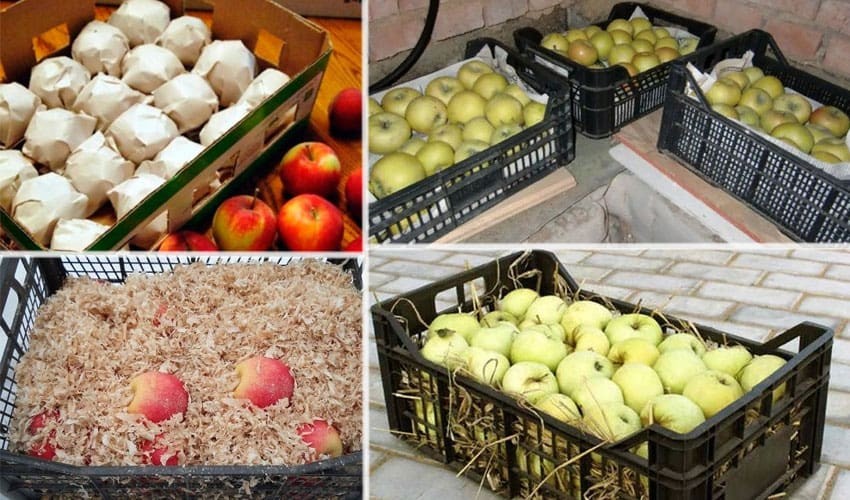
Make sure pests such as rats do not get into the room. They could destroy the entire crop. In the cellar it is necessary to have ideal conditions for storing fruit. Store apples in wooden boxes or baskets. Place them in at most two layers on top of each other so they do not knock against each other.