Article content
According to a study published in January 2015 in the journal Annals of Internal Medicine, more than half of an average person’s working hours are spent on activities associated with sitting.
This includes commuting to work, desk work or eating lunch.
Fix your spine damaged by sitting with the help of these 5 exercises
The research collected data from 47 other studies focused on a sedentary lifestyle.
It revealed that the amount of time spent sitting directly affects the increased rate of type 2 diabetes, cardiovascular disease, cancer1 and deaths from cancer.
What does prolonged sitting cause?
Long-term sitting has a negative effect especially on the health of your spine. Its stiffness and pain are among the most common health problems.
Over time the condition of the spine tends to deteriorate so much that it begins to affect your ability to exercise, run or perform other physical activities.
It is, so to speak, a downward spiral. The inability to perform physical activities leads to further deterioration of the condition, from which there is then no escape and spinal surgery becomes inevitable.
However, there are several simple exercises to correct damage caused by long-term sitting that should be performed regularly.
Today we’ll reveal 5 stretching exercises that will help you regain full range of motion and get rid of pain and stiffness not only in the back, but also in the knees and other joints.
1.”Fire hydrant”
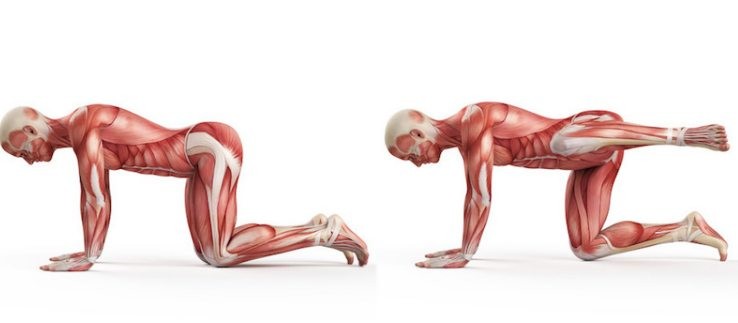
This exercise is known as the “fire hydrant” because it resembles a dog urinating on a hydrant.
To perform this exercise get on all fours (as shown in the introductory picture), with your palms and knees on the ground.
Now lift one leg to the side as high as you can. Then put the leg back and repeat the whole exercise as many times as you can.
This exercise will strengthen your legs and lower back. It will also improve your stability and balance.
2. Leg swings
This exercise is ideal for loosening stiff hip joints.
First stand up and hold onto something to help maintain your balance. Then start swinging one leg forward and backward as far as it will go. Later swing the leg to the sides.
Repeat the exercise several times, then switch legs and do the same with the other leg.
It is recommended to perform 15 to 20 swings with each leg for each type of swing (forward-backward and side-to-side), so a total of 30 to 40 movements with one leg and the same number with the other.
You can start with a smaller number of repetitions and gradually increase over time.
3. Squats
The aim of squats is to prevent stiffness. During this exercise you will stretch your legs, pelvis and spine.
The exercise is fairly simple. Squat down as low as possible and hold this position for several seconds.
Keep your feet flat on the ground and your back straight. Then stand up again, rest for a moment and repeat the exercise 5 to 6 times.
4. Bridge
With this exercise you will improve the flexibility and range of the hip joints as well as the gluteal and abdominal muscles.
Lie on your back on the floor with your knees bent and your feet flat on the floor.
Then lift your buttocks, lower back and hips so that your body forms a bridge. Hold this position for a moment and then slowly lower your body back onto the floor.
If you are more advanced or if this exercise seems too easy, you can place some weight on your abdomen.
Repeat the exercise 5 to 10 times depending on how much strength you have.
5. COUCH stretch
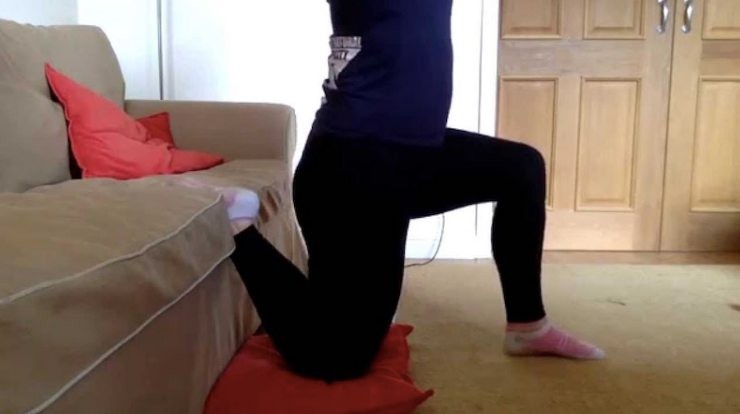
Stretching using the couch is a great exercise that you can do even while watching TV.
Kneel in front of the couch so that you bend one leg at the knee and place it in front of you, and kneel on the other knee with the foot of that leg resting on the seat of the couch.
Now straighten up and tense your glutes and abdominal muscles. Hold this position for 30 seconds, then switch legs and repeat the exercise.
Conclusion
Perform the given exercises regularly because they are extremely beneficial for you when leading a sedentary lifestyle.
Another way to overcome a sedentary lifestyle is to walk more often during work, of course if the nature of your work allows it. Also, instead of using the elevator, opt to walk up the stairs.