Article content
When my son was in second grade, I noticed that he often had trouble concentrating while studying. It took a long time before we even got to studying, even though suitable conditions had been created. He wanted to talk, his mind constantly drifted away from the material we were supposed to cover and he was always coming up with something just so he could leave the table. In word problems he often read only half the assignment and imagined the rest because he couldn’t be bothered to read everything.
This led to mistakes, even though after reading the entire assignment he would calculate the problem correctly. He panicked at longer texts; we regularly spent 2 hours at home on material that other children managed during class. The slower working pace then caused him frustration that the other children kept up and he did not.
I therefore decided to ask the school psychologist for a consultation and we were subsequently recommended to the Centre for Pedagogical-Psychological Counselling and Prevention. We began working on improving my son’s relationship with school and with learning. As a result of the pandemic we were dependent on distance learning and in addition we started to focus on activities that caused him problems. We didn’t look for excuses why it wouldn’t work, but for ways how it could. Thanks to various useful tips from the psychologist, but also from the football coach and the teacher, we found it and my son began to make significant progress. Therefore I would like to recommend these simple exercises to other parents who are going through similar learning difficulties …
Improving Concentration
It may seem strange to some, but one special exercise used in football training visibly helped us improve concentration. The psychologist later confirmed this to me as well, and she leaned toward the theory that sport leads to improved concentration. This exercise consists of the child tossing two small (equally sized and weighted) balls back and forth while simultaneously crossing the hands first with the right hand on top and then underneath.
It is very important that the child concentrates fully, because only then can they improve at this exercise, and this exercise simultaneously develops both the right and left brain hemispheres.
Video
Another similar exercise that helped us a lot was tossing small balls while simultaneously kicking a football from side to side. Both exercises are challenging at first, but with systematic training the child will begin to improve and it will benefit overall concentration during learning.
This exercise should be performed in place, but if at the beginning your child runs away like this (see video), that’s still better than nothing 😉 Over time they will learn to stay in place.
Repetition is the mother of wisdom
This saying applies doubly when a child has learning difficulties. It is appropriate to create some regular habit that they will take for granted and learn to accept as part of everyday life. Since my son had problems especially with a slow working pace and mainly had difficulties with writing and reading, we focused primarily on those two activities. I chose the rule of 5 sentences.
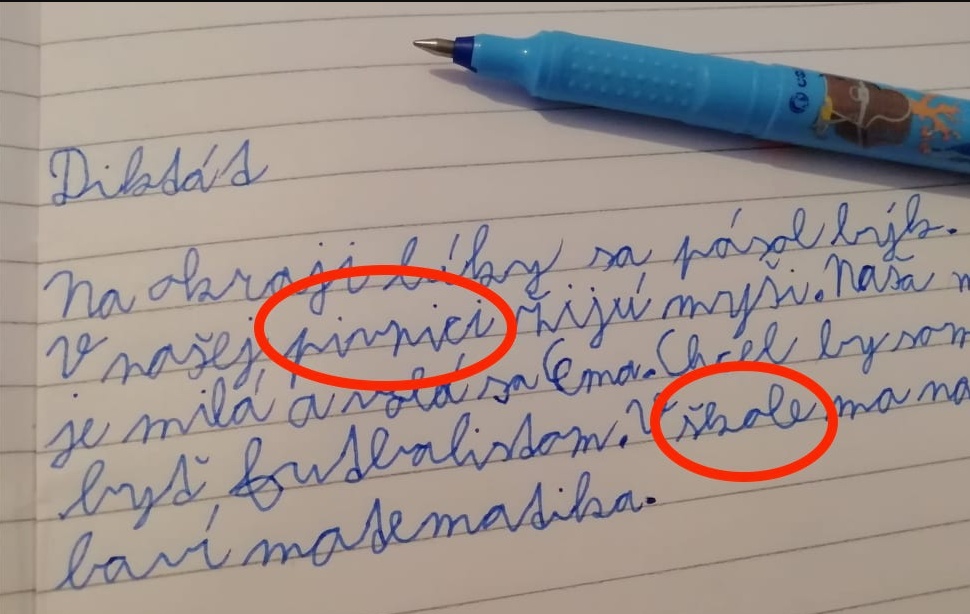
1. We set our daily routine so that every day we managed to write 5 short sentences. We followed this rule every single day, so my son already knew what to expect and was mentally prepared for it. Of course at first he resisted and really did not want to. Sometimes it took even an hour before he started writing at all and it was very demanding. However, after about a week he got so used to it that he prepared the dictation paper automatically without me asking. This procedure helped us significantly and my son began to visibly improve. His pace sped up and the error rate dropped significantly.
2. Besides writing, we made a ritual of short reading before bed. Since long texts terrified my son, I couldn’t go in headfirst and reach immediately for fairy tales composed of long continuous text. So I used his interest in encyclopedias and we started with short paragraphs on individual topics. Because he is interested in almost everything, I didn’t even have to persuade him. His eagerness for information motivated him to voluntarily add more and more to the short texts. Before we knew it he was reading whole pages …… by himself and voluntarily.
TIP: With longer texts we initially took turns. I read 5 sentences and he read the next 5. And this is how we read together until we finished the entire text.
(Book: Encyclopedia for Little Curious Ones – Why? How? Where?)
Imagination and Graphomotor Skills
My son was always more of a “live wire” and unlike my daughter he never sits still for long during activities such as drawing, painting, or molding with plasticine. It is clear that every child has a talent for something different and their interests vary. However, the reduced interest in these activities at an early age slightly complicated his completion of some tasks that involved drawing, for example in elementary science or in workbooks. For that reason he then had a slight aversion to these tasks because he was afraid of failing. I knew that the key to success could be strengthening his relationship with drawing. In this regard simple videos on YouTube helped us a lot.
As part of the “month of books” project my son was assigned to design his own little book on any topic. Since he loves animals, he decided to create a book about his visit to the ZOO. That was a great opportunity to practice not only writing but also drawing.
For each animal I found a tutorial on YouTube, prepared paper for him and for myself, and step by step we drew together. It was a pleasantly spent shared time and he gradually came to like this activity. We split the drawing and writing over several days and so every day we focused only on one animal. When he drew the first picture that resembled the original on YouTube, he felt proud that he had created it himself. That gave him confidence and further motivation to finish the whole book. After submitting the work he earned an A and a big compliment from the teacher for the beautiful execution and illustration. Since then he no longer tends to have a mental block with drawing-related tasks and although drawing will probably never be his passion, he enjoys this activity from time to time 🙂
I wish you and your little pupils lots of luck and patience with learning!