
Article content
We didn’t realize it could be done this way. A grower showed a unique method to propagate an orchid using only the stem from the plant’s spent flower and a plastic bottle. Without side shoots (keiki) and any special gardening preparations.
How to propagate an orchid
We need:
- A plastic bottle with a cap
- A long orchid stem without leaves
- Fishing line, a rubber band, or strong twine
- A mixture of sphagnum and peat moss
- Water
Procedure:
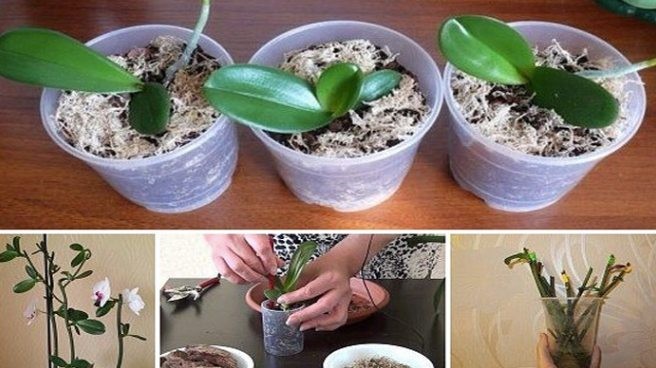
We divide the stem into two parts by cutting it above a node – the nodes must not be damaged because new roots will sprout from them (see video). Cut the plastic bottle in half so that the top part will serve as a roof. Let the peat moss and sphagnum soak in water. Then place both parts of the stem together and wrap the moist mixture around them and firmly secure it with fishing line or a rubber band. Put a little water on the bottom of the bottle, insert the wrapped and secured stems, and cover with the top half of the bottle, making holes in the cap for air circulation. Place it in a sunny spot and let nature do its work. New aerial roots will soon form from the nodes (buds). Then we can separate the stem and place each part with roots into a separate container. See the video for a detailed procedure!
Second method without peat
The second method seems simpler, but it leaves the nodes exposed and they are then treated with the so-called cytokinin paste, which strongly stimulates the growth of aerial roots – a new plant quickly forms from each node. You can find this paste, for example, online, or consult at a garden center. However, we recommend trying the first method at the start, which does not require such treatment. See how the second method works.
Propagation using Keiko
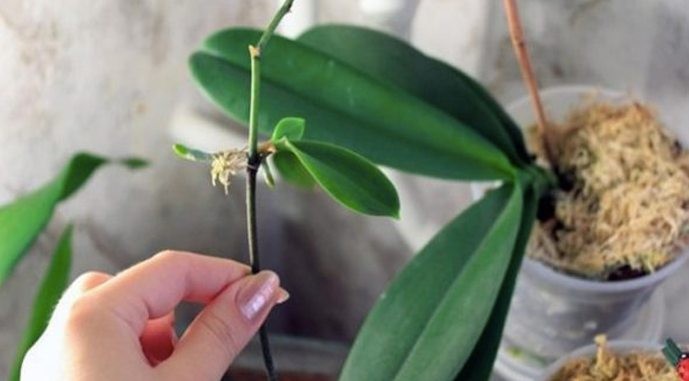
A shoot or Keiko represents the simplest way to propagate an orchid. Keikis grow on the parent plant and the orchid produces them mainly during periods when it is not blooming. However, we cannot remove a keiki from the plant at any time. The shoot must have formed aerial roots.
When propagating, simply cut off the shoot – the Keiko – from the plant. Prepare a container – ideally translucent (though this is not a requirement) and fill it with orchid substrate. Plant the shoot into the substrate, water lightly, and leave it in a sunny, warm place.
How do we recognize that a shoot is suitable for separation from the plant?
Keikis suitable for propagation should have their own aerial roots 5–10 cm long and 2–3 leaves. Keikis are separated with a piece of the flowering stem (about 2 cm above the plant). However, it is possible to obtain a new orchid from a shoot even if it does not have sufficiently developed aerial roots. It is enough to wrap it in moss and cover it with plastic – this will cause the aerial roots to grow quickly. Then plant the shoot into substrate.
Propagation in this way is particularly successful with Phalaenopsis and Dendrobium species.
Propagation by cuttings
This method is used for older plants and especially for Epidendrum and Thun species. The best time for propagation by cuttings is in spring or in the early summer months. Proceed by cutting off terminal or lateral shoots from the previous year. These should have at least one node with a new shoot.
Place the cuttings into a very airy substrate (made of moss) and they must be regularly moistened with a fine spray. Cuttings will begin to produce aerial roots earliest after 25 days. Keep them in a warm and bright place (but not in direct sunlight). At the beginning it is good to cover the planted cuttings with foil to maintain humidity.


