
Article content
The spiral-shaped tissue parasite, the cause of the disease, is very sensitive to external conditions. It enters the body through small cuts on the skin and mucous membranes, and even through intact skin and mucous membranes, but outside the human organism it dies quickly.
The infection is transmitted through sexual intercourse and during pregnancy (from mother to fetus), by transfusion and by contact with everyday objects only very rarely. The infectivity of the disease is not 100%, and it gradually decreases in later stages.
If you have so far thought that during unprotected sexual intercourse you are only at risk of AIDS and nothing else? You were wrong! This is a WARNING for everyone!!! Read carefully…
SYPHILIS
Casual sexual intercourse even with someone you know and trust in any way does not mean that they are not hiding something from you to be ashamed of, or worse. They may not know about it for some time and there may be a ticking bomb inside them.
What is syphilis?
Syphilis or lues can run a very protracted course, but what certainly does not take too long to appear is a rash on the genitals or elsewhere on the body. This rash appears on the body in the interval from the 10th day up to 3 months after the causative agent of syphilis penetrates the organism. A syphilitic rash is usually initially painless, can be several centimeters large, smooth and raised.
In women they tend to appear in the vagina or on the cervix, and since they are painless they often remain undetected. They disappear on their own, but the syphilis bacteria remain in the body. In some people syphilis may enter a latent stage, which means that no symptoms may reappear in that individual.
The consoling fact is that with proper diagnosis and early detection, syphilis, this sexually transmitted disease, is treatable.
Untreated syphilis progresses to the point where it damages your brain, nerves, eyes, heart, blood vessels, liver, bones and joints — then death follows!
Symptoms of syphilis
The first manifestation of syphilis (stage I) — on average 3 weeks after infection — is a 5–10 mm hardening that turns into the well-known hard ulcer (chancre). The ulcer is often “ham-colored”.
It most commonly occurs on the genital organs, but also in the oral cavity, on the lips, breasts and similar areas. It is painless, and when it is located in places not visible to the naked eye, it easily escapes attention.
About a week after the ulcer appears the corresponding lymph nodes enlarge, which also remain painless. After a while the ulcer heals even without treatment, but the disease continues.
About 8–10 weeks after infection syphilis progresses to stage II — spirochetes reach the whole body via the lymphatic and bloodstreams. Swollen lymph nodes appear in several places; they are only mildly enlarged and painless, and disappear after a few months.
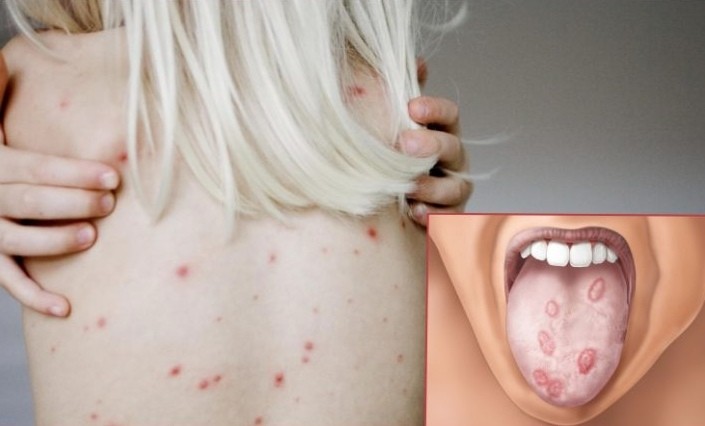
Skin manifestations of secondary syphilis are characterized by a symmetrical eruption of various rashes, which typically do not itch, do not hurt, and after some time disappear even without treatment.
The eruptions can recur several times. In addition to flat rashes on the body, raised lesions may also appear on the trunk, forehead and face. In skin folds, especially in the genital area and at the corners of the mouth, flat foul-smelling warts develop, which are among the most infectious manifestations of the disease.
Part of the manifestations of secondary syphilis can also be pigmentary disturbances, when white spots appear on the sides of the neck and near the armpits. In the 8th–12th week of secondary syphilis we may also encounter hair loss — either in the form of small bald patches that are often only noticed by a hairdresser, or hair loss over the entire head.
Attack on mucous membranes, mental disorders, dementia
The mucous membranes are not spared either. Bright red, very infectious spots tend to appear in the oral cavity. Tonsillitis-like manifestations, which occur without fever, are common, and a sweetish odor can be detected from the mouth.
Syphilis may not be accompanied by visible manifestations — most often the patient feels completely healthy and is unaware of their disease. In some cases, however, the following occur:
– malaise,
– loss of appetite,
– pallor,
– muscle pains,
– joint pains,
– nighttime pain in the bones and head.
After 3–5 years from infection untreated syphilis moves into stage III. There are only small numbers of bacteria in the organism and the disease is minimally infectious. In this stage lumps and nodules can form on the skin, which turn into ulcers and ooze a dark, foul fluid.
Gummas form anywhere on the body, most commonly on the shins, on the face and in the oral cavity, where they can perforate the nasal septum or the hard or soft palate. Gummas, also known as gummata, also form in internal organs — in the eye, brain, ear, lungs, liver — which leads to various complications.
After another 10–20 years syphilis progresses to the final stage — progressive paralysis (tabes dorsalis). The disease is accompanied by headaches, convulsions, the patient may suffer dizziness, stabbing and burning pains in the limbs. There are sensations of small insects on the skin, loss of coordination, intense pains (e.g. of the tongue, back) and the so-called tabetic gait, when one can hear the patient’s foot striking the ground (as a result of loss of sensation).
In the most severe cases there are disturbances of speech and writing, changes in psyche and personality, manic states, depression and dementia.
We conclude the recap with the sad news that syphilis is a fatal disease.


