
Article content
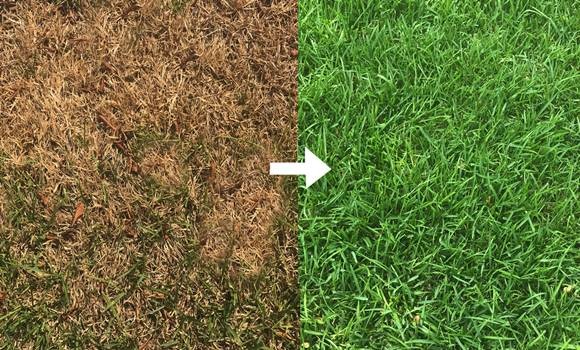
After the spring warming and heavy rains, the period of regular lawn mowing begins at the end of May and the beginning of June. Every weekend until autumn you can hear from country gardens the sound of a mower tackling dense growth. Well, only sometimes. In the summer months the lawn can suddenly fail to look its best; it may be pale or even turn rusty, and patchy bare spots appear. What to do differently to make the lawn look like a golf course?
Mulching during mowing
How can you ensure that the grass is nourished and the soil in the thatch does not dry out too much? During the first mowings it is advisable to set the mower without using the grass collector and let the lawn be mulched. The cutting height should not be less than 2.5-5 cm with regard to the terrain. The chopped grass residues retain moisture between the blades; they also reduce air penetration, but at the same time separating the blades from the thatch does not lead to root rot. If the grass is too tall, do not cut it down to the minimum at once, but reduce its height gradually.
Lawn watering
Already with the first days of summer temperatures the lawn begins to suffer, so it is advisable to water the greenery regularly. The most suitable time for irrigation is in the evening so that evaporation losses are as small as possible, because nights are cooler. Moreover, it is important to water thoroughly so that the water reaches the roots. According to gardeners the approximate volume of water is 15-20 mm for ordinary soil, and around 40 mm for clayey soil. Water immediately on the 5th or 6th day after mowing.
Fertilizing
Grass needs fertilizing just like other plants in the garden. It is appropriate to spread fertilizer and repeat the treatment every 2-3 months, including during the summer months. For this it is useful to loosen the lawn using crushed eggshells from eggs or to use other natural fertilizers.
Removing moss and weeds
To remove moss you can use a rake or a scarifier (verticutter) or remove it by hand on smaller areas just like other weeds, or alternatively purchase natural herbicides which should be used exactly according to the instructions for use.
Overseed the lawn
As soon as you notice defined and patchy areas, immediately mark off that area with sticks and sow grass seed so that a new lawn can emerge.
How to deal with brownish spots and fungi
Brownish spots arise where the soil is poorly aerated and drainage is poor, causing water to stand in which the lawn sits. Water encourages the development of moss and fungi, so it is good to aerate and fertilize the soil and, in cases of annual problems, use a fungicide right from spring. In case the brown spots continue to appear, try digging up the affected area and check whether beetle larvae are hiding under the grass roots; in that case use diazinon, isofephost or chlorpyrifos.


