
Article content
You don’t have to closely inspect your nails often, but did you know they can reveal quite a lot about your health?
Your nails even contain a record of your current health status and various physiological problems. They have been used in diagnosis since prehistoric times. Sometimes it can be a fungal disease or an injury. However, nails also provide clues to possible causes in the case of more serious diseases, such as lung, liver, or heart diseases.
Nails and health
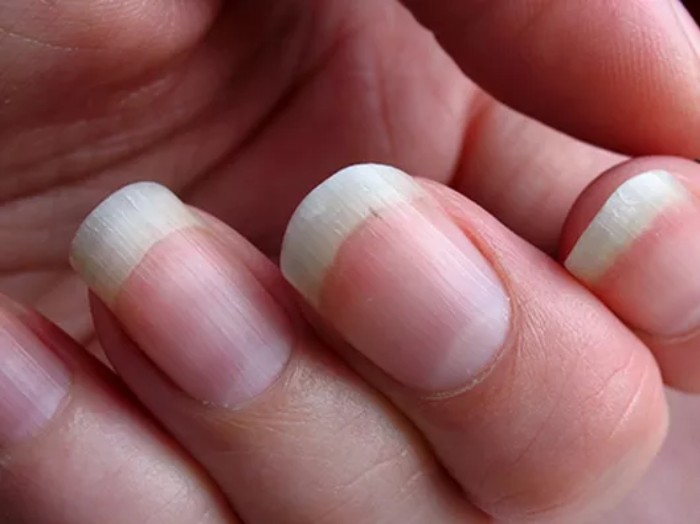
Healthy nails are pink in color and the lunulae at the base are light pink to white. They are also smooth, without ridges, grooves, spots, or loss of pigment. If you notice changes in any of these characteristics and don’t know what they may mean, you should for safety visit your doctor.
In this article you will learn how to interpret the signals sent by your nails.
1/ Bumpy or brittle nails
Bumpy or brittle nails can be the result of aging or frequent exposure to cleaning agents or nail polish. Other times it may be a sign of a fungal infection. Other causes include: lichen planus (a disease that causes itching on the skin and in the mouth), thyroid disease, or psoriasis. In rare cases it can also be a manifestation of reactive arthritis, which is a rather painful form of this condition.
2/ Loss of color
Yellow nails – may result from long-term use of nail polish, but also due to a fungal infection or psoriasis. In addition, liver problems, sinus infections, thyroid disease, lung infections, and lymphedema (buildup of fluid in the hands and feet) should be considered.
Green-black nails – indicate a bacterial infection that often develops under a loosened nail.
Blue or purple nail beds – occur with a lack of oxygen.
Gray nails – can be caused by certain types of medications.
Brown nails – indicate thyroid disease and malnutrition. Nails that are half brown at the tips and half white at the base may signal kidney failure, AIDS, but also appear after chemotherapy.
White nails – are usually a sign of aging, a fungal infection, or iron deficiency. It can also be cirrhosis of the liver, impaired kidney or heart function, diabetes, overactive thyroid, malnutrition, or the aftermath of chemotherapy.
3/ Thickened nails
They are most often caused by fungal infections, but can also be a result of psoriasis or reactive arthritis. Yellow, thickened, and slow-growing nails indicate lung disease.
4/ Loosened nails
When nails loosen and risk detaching from the nail bed, it can indicate an injury or infection. Thyroid disease, psoriasis, poor blood circulation or an allergic reaction to medication are also possibilities.
5/ Spoon-shaped nails (koilonychia)
When your nails curve inward, the possible causes may include:
- iron deficiency (anemia)
- hemochromatosis (a liver disease leading to excess iron)
- Raynaud’s disease (affects the blood supply to the fingers)
- heart disease
- underactive thyroid
6/ Pits or depressions in the nails
Pits or small depressions indicate psoriasis, eczema, reactive arthritis, or a condition called alopecia areata (loss of hair due to autoimmune diseases).
7/ Grooves across the nails
If you notice deep ridges running across the entire nail, they are usually due to the following factors:
- chemotherapy
- previous injury
- exposure to low temperatures
- Raynaud’s disease (blood supply to the fingers)
- diabetes
- vascular disease
- zinc deficiency
- illnesses that cause fevers
8/ Bulging nails
This occurs when the nails enlarge and puff upward. If it’s just due to increased blood flow, the condition is harmless. It is often an inherited trait. However, when it appears suddenly, the cause is a lack of oxygen, which indicates lung disease or other conditions, for example: heart disease, inflammatory bowel disease, diseased liver, or even AIDS.
9/ White lines across the nails
In this case white lines run parallel to the nail root. Do not confuse this with white spots or streaks, which are normal. However, if parallel white lines appear across the nails, it is a sign of low blood protein levels. This is a result of malnutrition or liver disease.
10/ Dark streaks running down the nails
This sign sometimes occurs in Black people and in most cases it is normal. Sometimes, however, it may indicate skin cancer affecting the nail bed. It is also called subungual melanoma. This type of cancer usually affects only one nail.
11/ Red or brown streaks under the nails
These are blood streaks caused by damaged blood vessels and capillaries. It is nothing to be worried about. However, if it affects several nails at once, it may indicate another disease.
Don’t ignore your nails and the health problems they may point to. Inspect them more often, because nails and overall health are closely linked. They offer you a window into your body and thus represent an excellent diagnostic tool.


