
Article content
Warts! Oh, they are so ugly and embarrassing! And you don’t even have to touch a toad to get them.
Anyone who has ever had warts or corns knows how hard they are to get rid of. In our article today we will offer both home remedies and standard medical methods for their removal.
This is a fairly extensive article in which we will gradually cover the following areas:
- Causes of wart and corn formation
- types of warts
- Treatment: How to remove warts and corns
- Prevention tips
- our recommendations
Causes of why warts and corns form
Warts are caused by a single virus, of which there are several strains. It is the human papillomavirus, also abbreviated as HPV.
This virus is one of the most widespread in the world. Up to 40% of the world’s population is infected with it. Because this virus directly causes growths on the skin, it is often also called the wart virus.
Although genital warts are the best-known disease caused by this virus, it can be said that almost all new growths on the skin are caused by HPV viruses.
The difference is in the subtypes, each of which produces warts on different parts of the body. These can be common, plantar (on hands and feet), flat or genital warts.
Common warts are caused by strains 2, 4 and 7. Plantar warts in the foot area are the result of strain 1. Flat warts are caused by HPV strains 3 and 10.
And finally genital warts are the result of the presence of one of more than 30 other strains of human papillomavirus.
What exactly are warts?
Warts are essentially viruses living in the skin and fed by vessels that supply them with all the necessary substances for life via the blood.
That is also the reason why their removal is often quite painful. These growths are attached to blood capillaries and firmly rooted in the skin.
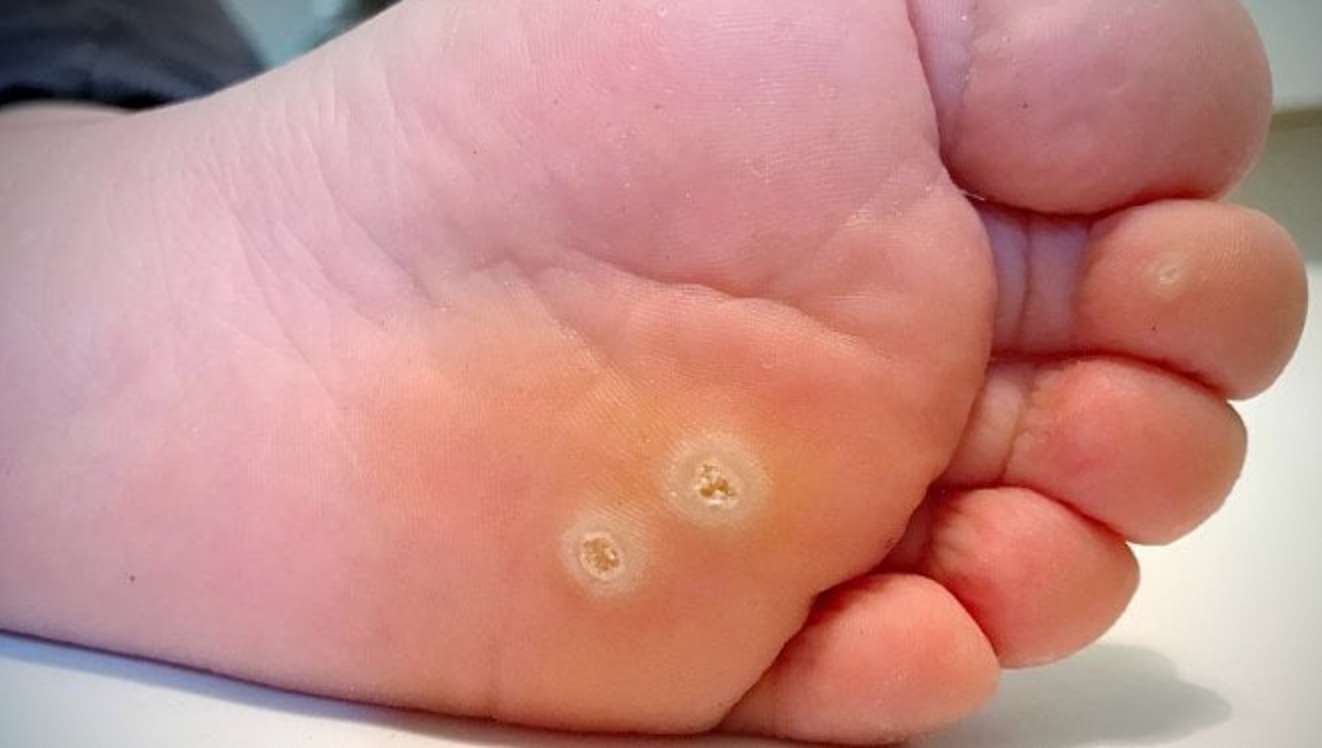
If you look at them more closely, you will see small black dots in their center. These dots are actually clotted blood vessels that feed the wart.
Warts spread when an uninfected part of the skin comes into contact with an infected area. Infection occurs either by direct contact with infected skin or by contact with pieces of skin torn off from warts.
It is assumed that for infection to occur, at least a small part of healthy skin must be damaged, i.e. there must be a small wound through which the HPV virus penetrates the body.
In other words – if you have a wart somewhere on your body and it comes into contact with damaged skin of another person, that person can become infected with the HPV virus and subsequently start to develop warts (including on hands and feet).
types of warts
Warts come in different shapes, sizes and appearances. Some are ordinary raised hardenings, others form in clusters.
Below is a guide to recognizing them and what to focus on when trying to determine what type of wart it is.
A. Plantar warts
This is a common type of growth that forms on the bottom or sides of the feet.
Because they are located on the underside of the feet, they tend to be flat and painful due to the body’s weight pressing on them. The wart is essentially much larger than what you see on the surface.
For example, when you press on a corn you will see a yellow area around it, which is actually the whole corn itself.
This type of wart is extremely contagious because pieces of skin often peel off the feet. Also the viruses that cause them prefer moist and warm places.
Therefore gym showers are a common source of infection. In fact, the occurrence of plantar warts among athletes is one of the highest in the population. Diabetics are also particularly susceptible to infection with these types of HPV.
B. Flat warts
This type of wart is, as the name implies, flat. They are also characterized by small size and a round or oval shape.
They also tend to occur in large numbers. It is not unusual to have 20 to 100 small warts scattered across the body.
In children they most commonly appear on the face. In men they may appear on the chin and in women on the legs. Small warts spread easily during shaving and the nicks that cause it.
And of course men often shave their faces and women their legs or armpits.
Spread of this type of warts can also occur when scratching the affected area. Their distribution is then often linear in the direction of the scratching.
C. Genital warts
Genital warts most often spread during intimate contact, affecting the places where mutual contact occurs.
They usually form as small, soft, pinkish growths. Over time they can harden, or elongate into the shape of a small stalk.
At other times several warts close to each other cluster into a cauliflower shape.
Most of these warts are painless and after a while, usually within a few months, they disappear on their own. However, they are also incurable, which means they can return again and again at any time.
Treatment: How to remove warts and corns
Three methods are usually used to remove warts and corns: over-the-counter pharmacy products, various home remedies and finally surgical methods.
I. Over-the-counter pharmacy products
Fortunately for you, most warts will disappear on their own after some time. However, if you want to speed up this process, there are a number of over-the-counter products you can try.
Most of them work on the principle of freezing them (a mixture of diethyl ether and propane) or burning them (salicylic acid). These methods also destroy the virus contained in the wart.
Examples of such freezing products are, for example:
- 1) wart and corn pen
- 2) applicator for warts and corns, 2nd generation
The mentioned products are not recommended for warts on the face or intimate areas, because the skin in these parts of the body is relatively sensitive.
II. Home remedies
There are a large number of home remedies and guides for removing warts. The best known include these:
3) adhesive tape
Cut a piece of adhesive tape so that it covers the corn and stick it on. Leave it there for 6 days.
Then remove the tape and put the affected skin area into water for a few minutes. Then use a file to remove part of the top layer of the corn.
Let the area dry, preferably overnight.
Then in the morning apply a new piece of adhesive tape and repeat the process until the corn or wart disappears.
It is believed that this method is effective because mild irritation of the affected area forces the immune system to deal with the infection and the HPV viruses are gradually destroyed over time.
4) garlic
Mash a clove of fresh garlic into a fine paste. Then apply it directly to the wart or corn and cover the area with a plaster.
Apply fresh garlic every day. The wart will soon blister and fall off within a week.
Be careful not to apply garlic to the surrounding healthy skin. It is quite aggressive and could damage the skin. For this purpose it helps to spread a little oil or petroleum jelly on the surrounding skin before application.
5) vinegar
Soak a wad of cotton in vinegar and stick it with a plaster onto the corn or wart for at least an hour or two a day.
6) dandelion sap
Pick a dandelion from your garden or anywhere near the house, break the stem and drop the sap that comes out onto the wart.
Do this daily until it falls off.
The sap will mildly irritate the skin and thereby stimulate your immune system to get rid of the wart. However do not use dandelions that grow in places treated with herbicides in recent years.
7) vitamin C
Crush vitamin C tablets into powder, add a few drops of water and make a paste.
Apply it to the corn and cover with a plaster. The high acidity of vitamin C will help remove it and at the same time encourage the immune system to act.
For this purpose, however, use vitamin C in the form of ascorbates.
Non-acidic forms, such as calcium ascorbate, would also support the immune system but would not have a direct effect on the wart.
8) banana and lemon peel
Cut off a piece of banana or lemon peel, apply it to the wart and cover with a plaster before going to bed.
Chemicals and oils contained in the peel will help dissolve and remove the wart.
9) papaya
Take an unripe papaya and make a few cuts in it so that sap flows out. Collect this sap and let it harden in the air.
After it hardens, dilute it a little with water and spread the paste on the affected areas morning and evening. The enzyme in papaya digests the wart and dead skin parts.
10) basil
Stick chopped and crushed basil onto the wart using a waterproof first-aid plaster.
Do this every day and within a week the basil’s virus-destroying substance will kill your wart or corn.
11) castor oil
Rubbing castor oil on the wart will break it down within a week. This will be because the oil leaves the skin supple and over time the hardened skin will simply crumble.
12) aloe vera
If you happen to grow aloe vera at home, tear off one leaf and rub the gel that flows out onto the wart.
Do this every day and the wart will almost disappear. The likely cause is the malic acid found in aloe vera.
13) warm water
Since plantar warts are sensitive to heat, soaking your feet in hot water (43 to 45 degrees Celsius) for 15 minutes daily can remove them.
III. Surgical methods for removing warts
If no over-the-counter products or home methods for removing warts have worked, there are a few types of surgical procedures that your conventional doctor may recommend.
These include the following:
14) cryosurgery
Liquid nitrogen is used to freeze warts. It freezes the wart or corn and also destroys the affected tissues. However, it requires repeated visits.
It also often leaves scars and is not infrequently quite painful, so the doctor may give you a local anesthetic to alleviate the pain.
15) electrocautery
This is the application of a high-frequency electric current. Usually a very painful method.
16) lasers
Like freezing, they can leave scars.
However, lasers do not destroy the viral root and therefore warts often return after this procedure.
17) surgical excision
The wart is simply cut out. Because a scalpel is used and it cuts into living tissue, local anesthesia is necessary.
Scarring is also a common consequence.
18) cantharidin treatment
The chemical cantharidin is produced by blister beetles, which are also known for producing the aphrodisiac Spanish fly.
This substance is diluted and applied to warts usually painted on a plaster and left on for 24 hours.
There are also methods where cantharidin is diluted with other chemicals. In these cases a 2-hour application is sufficient. This method is not painful at first, but severe pain comes 3 to 8 hours after application when the wart blisters.
Subsequently a visit to the doctor is necessary to remove the dead skin.
If the wart is not completely removed, the procedure must be repeated. Its success, however, varies.
Warning: cantharidin is an extremely poisonous substance, similar to strychnine. Ingestion of only 10 mg can be fatal.
19) imiquimod
This is a drug most commonly used for genital warts. It is also prescribed for plantar and flat types.
It is applied to warts once every one to three days.
The cream activates the immune system to respond against HPV viruses. The skin around the wart often BECOMES REDDENED.
20) bleomycin (a substance used against cancer), cimetidine (an antihistamine) and tretinoin (a vitamin A derivative used in some acne preparations)
All of the listed substances may be injected directly into warts that are otherwise very difficult to remove.
Prevention tips
The most effective prevention of warts and corns is to avoid infection with the papilloma virus (HPV). The following tips will help you with that:
- Wear sandals on your feet in public showers, locker rooms and at pools. These warm and humid environments are ideal for viruses
- Do not touch any warts, whether your own or someone else’s
- Do not share socks, shoes, razors or towels. Although a wart is not visible on someone, that doesn’t mean the virus isn’t present there
- Keep your feet dry. If your feet sweat excessively, wear socks that wick moisture well
- Prevent injuries to the feet. Warts and corns attach more easily to areas with damaged or broken skin.
Tips to prevent the spread of warts:
- Cover your warts with a plaster.
- Do not bite your nails and the skin around them. This can spread the virus from one hand to another.
- Dry your hands well after washing. Warts are more easily transmitted when wet. This will significantly reduce the risk of infecting someone else
- Leave warts and corns alone. Do not scratch or pick at them, because during that the virus can spread to other areas of your skin.
Our further recommendations regarding diet and supplements
As described in the article, it is important to prevent infection with HPV viruses that cause warts and corns. However, due to their spread in the population, this can be quite difficult.
We recommend: Natural Thyroid Treatment
If infection does occur, two problems arise. The first is the actual removal of warts, the second is their frequent recurrence.
Therefore the only lasting solution is to strengthen your immune system so that it can handle and suppress these infections on its own.
Since the cause is the same as with problems of the cervix, the solution is similar. You can find it, for example, in the article Natural alternative to vaccination against cervical cancer.
For clarity we will repeat it here:
morning
– Selenium, 200 to 400 mcg (micrograms)
– Zinc, 50 mg
– Quality multivitamin, once daily
– Rinse affected areas with colloidal silver. Optionally both rinse and drink colloidal silver. One dose = 0.25 dcl (a quarter deciliter, i.e. 25 milliliters). Of course do not drink it right after rinsing, but drink it plain.
During the day
– Aloe Vera, 3 × 2 tablespoons (If concentrated, dilution is necessary. Always follow the instructions on the bottle).
– Olive leaf extract, 3 × daily (ideally with at least 20% oleuropein content).
– Vitamin C, together daily 1000 to 2000 mg of ascorbates (preferably a combination of different forms of vitamin C).
– From the diet, if possible exclude: sweets, white bread, sweetened drinks (Coca Cola and similar). Also avoid artificial sweeteners (Coca Cola Light, Pepsi Light). These are even added to many artificially sweetened mineral waters. Likewise avoid other “light” products containing mainly aspartame.
– If possible, stop using hormonal contraception (use alternative forms of contraception).
evening
– One probiotic with some fruit, for example an apple before bed.
– Again rinse the affected areas with colloidal silver. Optionally both rinse and properly drink colloidal silver. 1 dose = 0.25 dcl (a quarter deciliter, i.e. 25 milliliters). Of course do not drink it right after rinsing, but drink it plain.
Appendix:
Olive leaf can also be supplemented with stronger antiviral preparations:
– betulin (extract from birch bark), 2 × 500 mg daily
– Befungin (extract from the chaga mushroom), 7-10 grams daily
– Larrea tridentata, 2 × 1 gram daily
Other supplements that can be added to the regimen (recommended but not necessary):
– Vitamin E, 200 to 600 IU daily
– oregano oil, 3 × 300 mg daily
– Drinking coconut oil, 1 to 3 tablespoons daily
– Beta glucans, 2 to 3 × daily 500 mg (i.e. together 1000 mg to 1500 mg)
– Iodine (iodine tablets or seaweeds Kelp or Spirulina)
– Enzymes, for example: Bromelain, Papain or Serrapeptase
– Other antiviral and antiparasitic preparations
Where to buy the desired supplements advantageously
A detailed list of supplements suitable for warts, corns, but also a number of other diseases can be found in the article Recommended dietary supplements.
We hope this article helps solve your health problem.


