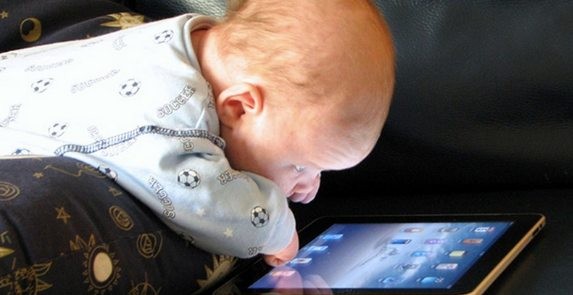
Article content
If you belong to Generation Y like us, you’ve probably thought a lot about how to raise your children these days (assuming you don’t have children yet).
Especially regarding technology, a lot has changed since our childhood in the 1990s.
Here is the question: Would you let your child use such a little wonder as an iPod, iPad, or another tablet?
Steve Jobs, founder and until recently the top representative of Apple, was fairly clear on this – he wouldn’t. And he had a good reason.
New York Times reporter Nick Bilton once casually asked Steve Jobs: “Your children must love the iPad, right?”
Jobs replied:
They don’t use it. At home we limit how much technology our children use.
Especially in the California area known as Silicon Valley, a trend is spreading among directors and development workers to protect their own children from the influence of technology.
They even send their children to schools without technical aids.
An example of such a school is the Waldorf School in Los Altos, where you would look in vain for computers. They focus exclusively on manual types of learning there.
The Times once published a well-known statement from Chris Anderson, director of 3D Robotics and father of five. In it he explains what leads people from the technology industry to such a stance:
My children accuse my wife and me of being fascists, too concerned about technology. They tell us that none of their friends have the same rules at home …
It’s because we experienced the dangers of technology firsthand. I saw it in myself and I don’t want to see the same thing in my children.
With our current dependence on iPhones and other advanced “toys,” there’s a danger we will raise children with an incomplete, handicapped life, without a pinch of imagination or creativity.
We were the last generation that played outside.
It was precisely because we didn’t have smartphones or laptops available. We learned from movement and hands-on interaction. We absorbed information from books or by socializing with other people, not from Google searches.
Learning in the traditional way helped us become well-rounded personalities.
Therefore we should fear that we are depriving our children of the skill of playful communication or the ability to entertain themselves with a rubber band or jump rope all day if their smartphone happens to stop working.
If we ultimately do give them that smartphone, we shorten their opportunity for a healthier, less dependent environment.
I think Steve Jobs was right about this with regard to his children.
Summary of the effects of tablets on children
When using iPads and other tablets, children experience the following effects:
- Children with a tablet do not move. Yet people remember best when learning is linked with movement. Not like children playing outside.
- Children with a tablet do not adjust their eyes. They do not alternate the eye’s accommodation for distance and near. Not like children playing outside.
- Children with a tablet do not speak. Not like children playing outside.
- So children with a tablet do not sufficiently develop the motor center, the visual center, or the speech center in their brain. Mostly what
develops is only their laziness.
A lesson for the future
If you next contemplate how to properly raise your children, you should think (very) carefully about whether you will buy them every shiny technological novelty while they are growing up.
Play with them outside, surround them with nature.
They may hate you for it now, but without a doubt they will thank you for it later. I bet that’s exactly how most of us feel now that we are older.
A little spicy ending
To finish, a small spicy bit – a short video of a child who doesn’t understand why the “iPad” isn’t working.