Article content
You’ve probably already heard about the health benefits of olive oil, which is an integral part of the Mediterranean diet.
People have been using olive oil for millennia. According to one legend, it was consumed by Hippocrates, the father of modern medicine.
Health benefits of olive oil
This type of oil has many health benefits. It contains high amounts of monounsaturated fatty acids, which have beneficial effects mainly for heart health, but also for other parts of the body.
Many medical experts confirm that a Mediterranean diet rich in olive oil can reduce the risk of developing type 2 diabetes. It is also beneficial for bones and weight loss and improves brain function.
In addition, olive oil helps regulate regular bowel movements and can even alleviate anxiety.
Besides the mentioned monounsaturated fatty acids, it also contains large amounts of phenolic acids.
It is an acidic substance that gives olive oil its typical bitter taste. This compound is extremely beneficial for heart health.
Olive oil also contains vitamins E and K, which are important for healthy skin and hair.
What does “extra virgin” mean? Is there really anything “virgin” about it?
It’s good to know that the term “virgin olive oil” doesn’t say anything about its quality, nor about extra purity.
The real difference between olive oils lies in their production process (and of course in the quality of the raw materials used).
There are 4 grades of virgin olive oil.
The lowest quality is used for soap production and is not suitable for human consumption.
The highest quality is found in oil that is cold-pressed. This type also has the best taste and aroma. It should never be heated above 40 degrees Celsius.
It should also be known that fake types of olive oil commonly occur in stores, especially when it comes to “extra virgin” olive oil.
Olive oil test results
A group of researchers from the University of California conducted a test among several well-known brands of olive oil in the USA that were labeled “extra virgin oil”.
The test results were truly shocking. Nearly 70% of these oils were fake!
Therefore, when you next see the label “extra virgin olive oil” on a bottle, be extra cautious.
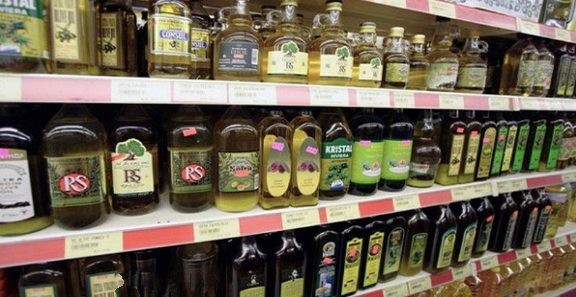
And now we slowly come to the million-euro question: How to distinguish real olive oil from fake when shopping in a supermarket?
To be honest, you can’t tell it directly in the supermarket.
You will have to buy some and test it at home. The tastes of real and fake olive oil are often (though not always) similar, so you will need to find other ways to distinguish them.
What does “counterfeit olive oil” mean?
Basically, fake olive oil most often means a blend of two different kinds of oil – usually part sunflower oil and part real olive oil. The latter is sometimes labeled as “extra virgin oil”.
But it can also be a mixture of olive oils of different quality, from different parts of the world.
In the worst cases, there are even blends of sunflower and soybean oil with added colorings like chlorophyll or beta-carotene, which traders do not hesitate to label as “olive oil”.
Therefore, beware of names like “extra pure” or “extra virgin”.
Even many TV commercials that claim to sell only the highest quality olive oil lie and in reality sell fake oil. Current research has found that this concerns more than one well-known brand.
How to tell real olive oil from fake?
In this part of the article we will try to clarify the important question of how to distinguish these oils from each other.
1. Cold test
You can perform this simple test at home. Take the oil and chill it, for example in the refrigerator.
If the oil solidifies, it means it contains monounsaturated acids, which are typical for real olive oil.
However, this test is not 100% reliable. If it’s a fake oil that is a mixture of real olive oil and some other oil, it will contain some of those monounsaturated acids and thus it will also solidify when exposed to cold.
Therefore, additional home tests will be needed.
2. Fire test
Real olive oil should be able to burn in a household kerosene lamp.
If you don’t have one (who nowadays has kerosene lamps at home, right?), then you can pour olive oil into a glass, put a candle wick in it and try to light the wick.
If the oil cannot sustain a flame, then it is probably fake olive oil.
Again, this test is not completely reliable, especially in cases where the oil is a mixture of olive oil and some other oil.
3. Taste test
As you know, olive oil should have a distinct, slightly bitter taste. If it doesn’t, it is likely adulterated oil.
The problem is that “high-quality” counterfeits may have additives that mimic this taste.
So what then? How can you be sure whether the oil is real or not?
A guaranteed way is to buy olive oil from a producer you know and who can guarantee its authenticity. This is not a problem in countries where olive oil is produced, such as Italy.
But what about Slovakia, where there are only importers and distributors? Fortunately, there is a solution here too.
4. Look for certificates of authenticity
When buying olive oil in a supermarket, always look for third-party certificates displayed on the packaging.
Whether it’s an organic label or a collective label that guarantees the authenticity and genuineness of the food.
If you buy oil produced in Italy, look for the PDO (Protected Designation of Origin) or PGI (Protected Geographical Indication) labels.