
Article content
The American Academy of Pediatrics (AAP) released a report in December 2018 that says the greatest benefit for children comes from simple toys.
They warn parents against filling the toy box with light-up toys and other electronic devices.
The report is titled “Choosing Appropriate Toys for Young Children in the Digital Age”. It offers parents guidance on which toys will most benefit their child’s development. The report focuses on children from birth through school age.
Walking down the toy aisle in any big store can make it hard not to notice all the electronic and digital toys and games they have. Although these toys may be appealing to parents and children, the AAP recommends buying the simpler ones.
“Over the years toys have evolved and advertising can leave parents with the impression that toys based on virtual or digital platforms are more educational,” said Aleeya Healey, MD, FAAP, in an AAP press release.
Healey is the lead author of the report. She adds:
“Research tells us that the best toys don’t have to be flashy or expensive, nor do they have to have any app. Simplicity really is better in this case. “
Interaction and imagination
The study emphasizes the importance of play for a child’s development. “Play is essential for optimal child development because it contributes to the cognitive, physical, social, and emotional well-being of children and adolescents,” the report states.
The study authors also confirm how extremely important it is for children to be engaged in play with their parents and caregivers. Toys can help facilitate this interaction.
“The best toys are those that encourage shared play, pretend play, and interaction between parents and children,” said in a press release Alan Mendelsohn, MD, FAAP, who is a coauthor of the report and an associate professor in the Departments of Pediatrics and Population Health at NYU Langone Health.
According to Mendelsohn, digital toys do not provide the same benefits.
Although media-based toys, such as videos, computer programs, and audiobooks, are touted as interactive and educationally beneficial, the AAP says these claims are unfounded.
Mendelsohn says:
“A tablet or monitor simply won’t provide the same reward.
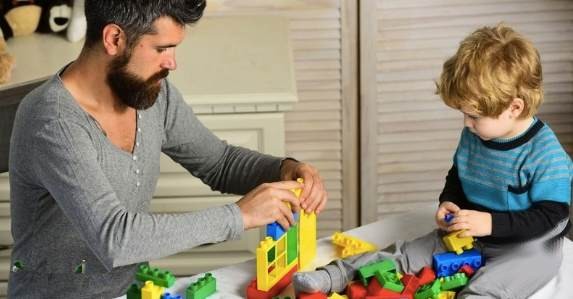
And when children play with their parents – a real miracle occurs, whether they play together with toy figures, or build together with blocks or assemble puzzles. “
Recommendations for simple toys
According to the AAP report, caregivers should seek out toys that support ” cognitive development, language interactions, symbolic and pretend play, social interactions, and physical activity “.
Children can engage in pretend play with toy characters, such as dolls, animals, and figurines. They can also play with toy objects, such as food, vehicles, tools, and construction.
Pretend play can help children learn to use words to “imitate, describe, and cope with real situations and feelings”.
Another aspect of child development that toys can facilitate is problem-solving.
Children can play with blocks and puzzle pieces to develop their fine motor skills, language and cognitive abilities, spatial awareness, and early math skills.
These are just a few ways simple toys can support child development and this is not an exhaustive list.
Conclusion
What the AAP most emphasizes is that children’s skills develop best when they play with their parents and other caregivers. So roll up your sleeves and grab some toy food.
Be prepared to engage your own imagination to help your child develop theirs!


