
Article content
“Coronavirus spreads into the surroundings when an infected person coughs or exhales droplets of infected fluid. These then fall onto surfaces and objects such as tables, computers, phones, or possibly food, etc.,” says the Ministry of Health.
If someone else picks up a contaminated object or touches such a surface, they can become infected.
The fundamental rule is therefore regular treatment with a disinfectant.
Judging by the empty shelves in stores, people apparently take this recommendation seriously. However, they probably forget about one item they use daily and for which it is not unusual to end up in other people’s hands.
We are talking about the mobile phone.
Yet its regular cleaning should be essential. As earlier studies have shown, a mobile phone is literally a reservoir of bacteria and viruses.
For example, the British company Initial Washroom Hygiene found in a 2018 study that a mobile is seven times dirtier than a toilet seat (see more: Mobile phones are a collection of bacteria. There are many more of them than in the toilet).
Users almost never disinfect its surface. And apparently nothing changed that, not even the Ministry of Health recommendation mentioned above. According to a 2014 study, users touch their mobile on average 221 times a day; currently this number is certainly significantly higher.
So if a coronavirus-infected user sneezes or coughs at the moment when they are holding the mobile to their ear or in their hand, droplets with the infection adhere to the surface of the phone. Anyone who subsequently picks it up can become infected. This risk can be eliminated in two ways.
First, do not use someone else’s phone, which would also mean that an infected user must not even put it down on a table — that is, on a surface that other people come into contact with.
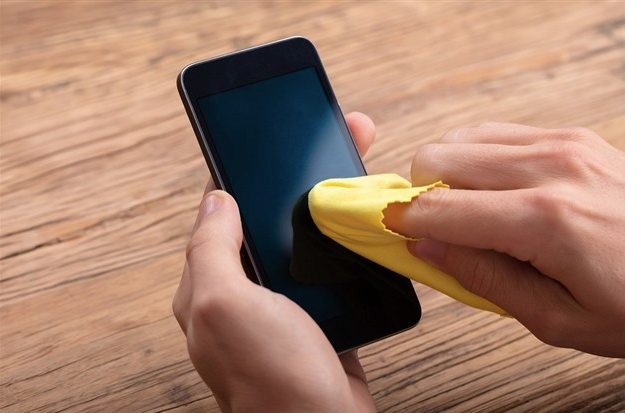
However, the most effective prevention is disinfecting the phone’s surface. And not just the display, but the sides and back as well.
Be cautious when cleaning a mobile
Perhaps the most ideal way to disinfect a mobile is a UV lamp. There are also ones specifically for phones, but they are not commonly available. A more accessible option is disinfectant wipes. However, not all manufacturers recommend their use.
Not only when using disinfectant gel is it necessary to proceed with care. From our own experience we recommend putting a small amount of gel onto a cotton swab and then using it to gently wipe the phone’s surface.
Turn off the mobile, use a microfiber cloth and a minimal amount of liquid
According to Debris Goff, a founding member of the antimicrobial surveillance program at the Wexner Medical Center at Ohio State University, the first step a user should take before cleaning their phone is to turn it off and unplug it from the charger. Goff also recommends using a microfiber cloth for cleaning. “These specially designed fabrics have more fibers than other types of cloth, so they capture more microscopic particles including bacteria and viruses,” Goff explained.
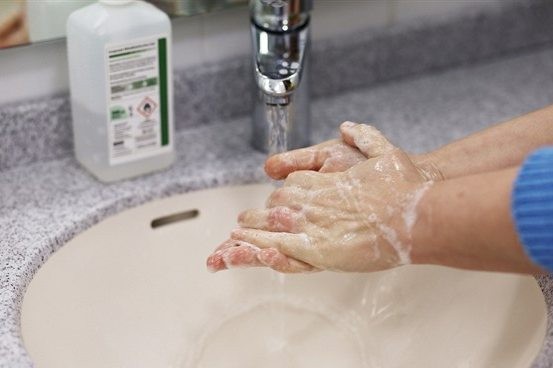
Although it can capture particles when wiping the surface — and without using water — that does not mean they are destroyed. It acts like a kind of “magnet for viruses”, which is why it must then be disinfected. After that, the user should also always wash their hands.
If a microfiber cloth is not available and the phone is heavily soiled, Goff recommends using a solution of 60% water and 40% alcohol. It is generally recommended that an effective disinfectant solution should contain no less than 60% alcohol, with 70% being the most effective.
Dip the corner of the cloth into the prepared solution and gently clean the phone.
According to Goff, soapy water is also sufficient; in both cases it is necessary to wring the cloth out thoroughly. It must not be too saturated with water. We should add, however, that this procedure is contrary to the recommendations of Samsung and Apple mentioned above.
However, according to Goff, you should definitely avoid cleaning agents with additives. So forget about things like window cleaner, hydrogen peroxide or vinegar.


