

Article content
Nobody wanted to hear such a report. According to recent findings, the coronavirus can survive in the air longer than was previously assumed.
The coronavirus is transmitted by droplets, mostly from sneezing or coughing.
As stated by WHO lead expert Marie Van Kerkhove, these droplets can not only adhere to a surface, but also survive in the air under certain conditions. According to the doctor, it mainly depends on humidity and air temperature, or possibly on radiation.
On the basis of these new findings WHO is considering introducing new safety measures for healthcare personnel. „In hospitals we have many aerosol procedures, when quite a few particles get into the air, something can happen that we call aerosolization, thanks to which these particles in the air can then survive longer,“ Van Kerkhove said.
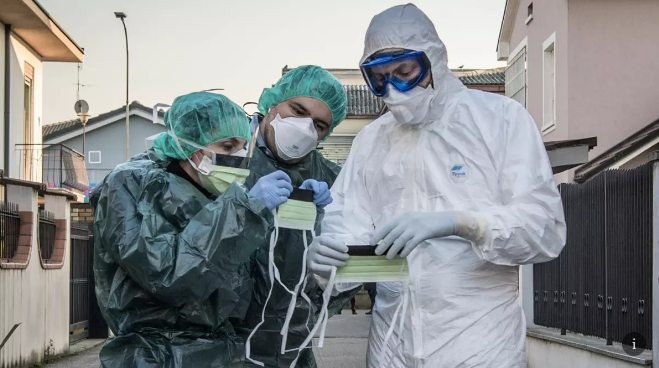
„It is therefore very important that staff adopt additional measures if they work with patients undergoing these aerosol procedures, such as chest X-rays,“ she also clarified that doctors around the world are aware of the conclusions of the new study and are likewise testing how the coronavirus behaves in different environments.
The U.S. Centers for Disease Control and Prevention (CDC), for example, examined in depth how long the coronavirus survives on various surfaces. „On copper or steel it lasts two hours,“ announced CDC chief Robert Redfield. „But on cardboard or plastic it lasts longer, we are now examining how long,“ Redfield added.
WHO Director-General Tedros Adhanom Ghebreyesus on Monday, March 16 called on all states to begin testing their citizens for the coronavirus. „We have a simple message for all countries: test, test, test,“ Tedros said at a Monday press conference in Geneva. According to him, testing programs are the best tool to slow the progress of the pandemic.
According to the WHO chief, without testing it is not possible to isolate individual cases of infection and break the chain of transmission.
Tedros further said that cases with a mild course of COVID-19 should be placed in home quarantine in those countries that do not have sufficient hospital capacity.
According to the World Health Organization (WHO), over 182 thousand people worldwide have already been infected with the new coronavirus and at least 7,135 have died of COVID-19. Although the symptoms of the vast majority of patients are rather mild, in about 20 percent of them the infection causes a serious condition. According to WHO, 3.4 percent of those infected die from the coronavirus.


