Article content
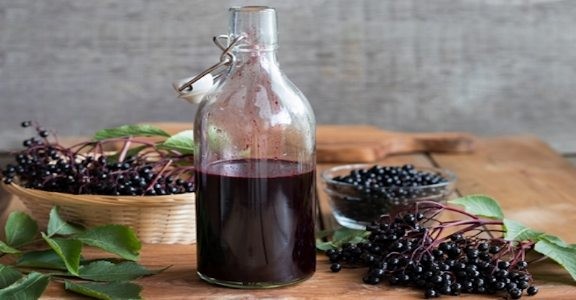
Elderberry is, for me, one of the most commonly used remedies for the cooler months. Dried fruits of the plant Sambucca nigra (Black elder) naturally contain many immune-supporting components that have been shown specifically to help defeat colds and flu more quickly.
They can be used to prepare a whole range of remedies. My favorite is a simple elderberry syrup.
Elderberry: a natural remedy for mild colds and flu?
There is definitely a time and place when it is necessary to use conventional medicine and visit a doctor. Unfortunately, however, there is not much that conventional medicine can do for the common cold or a mild case of the flu.
If you or your child have ever had a bad case of a cold or the flu, then you know how nasty they can be. It is especially awful for mothers to see their children feeling so unwell and not be able to fix it.
Fortunately, nature offers some remedies that, when used, can help avoid minor illnesses and shorten their duration.
It has been shown that black elder (Sambucus nigra) helps to prevent these illnesses and speeds recovery in those who already have them. I have also found that it apparently offers some relief from symptoms during minor illnesses.
Benefits of elderberry
Elderberry naturally contains vitamins A, B and C and stimulates the immune system.
Israeli scientists found that the complex sugars in elderberry support the immune system in suppressing colds and flu. Based on these complex sugars they developed several formulas that were clinically shown to help improve all kinds of colds/flu.
In fact, Dr. Madeleine Mumcuoglu of the Hadassah Medical Center at the Hebrew University in Israel found that elderberries neutralize an enzyme that viruses use to penetrate healthy cells in the nasal and throat mucosa.
When taken before infection it prevents infection. When taken after infection it prevents the virus from spreading in the respiratory tract.
In a clinical trial 20% of study participants reported a significant improvement within 24 hours, 70% within 48 hours and 90% reported complete recovery within 3 days.
By contrast, participants taking a placebo needed 6 days to recover.
Elderberry syrup: how to easily get the benefits
Elderberry syrup provides concentrated benefits of black elder to support immunity in a delicious-tasting form.
My homemade recipe uses a home-prepared elderberry concentrate, together with enhancing herbs such as cinnamon and ginger and, for an extra immune boost, raw honey.
If you do not use honey, or cannot use it, see the suggested substitutions below the recipe.
Why make your own?
First of all, you will save a lot of money!
Several natural elderberry syrups can be found in health food stores or online, but they usually cost around 10 Eur for 100 to 200 grams.
This recipe makes 400 grams at a much lower price and the kids will love the taste! You can also fully customize it based on your needs and preferred flavors.
Still, when dried elderberries are not available and you are in a pinch, there are some great ready-made elderberry juices and elderberry syrup that work just as well (they just cost more).
And also, if you happen to have fresh or frozen elderberries on hand, just double the amount given in the recipe.
Elderberry syrup recipe
Simple recipe for tasty elderberry syrup, made from dried elderberries, honey and spices to boost immunity.
Can be used as a remedy, or on homemade pancakes or waffles.
Medicinal course
Preparation time: 5 minutes
Cooking time: 1 hour
Total time: 1 hour 20 minutes
Yield: 2 cups
Ingredients:
- 3½ cups water
- 2/3 cup elderberries (dried or 1 plus 1/3 cups fresh or frozen)
- 2 tablespoons ginger (grated)
- 1 teaspoon cinnamon
- ½ teaspoon ground cloves
- 1 cup raw honey
Procedure:
1. Pour the water into a medium-sized saucepan and add the elderberries, ginger, cinnamon and cloves.
2. Bring to a boil, then cover and let simmer for about 45 minutes to an hour, until the amount of liquid has reduced by almost half.
3. Remove from heat and let cool until the mixture is cool enough to handle.
4. Using a spoon or other flat tool, thoroughly crush the berries.
5. Pour through a sieve into a jar or bowl.
6. Discard the used berries and let the liquid cool until lukewarm.
7. When it is no longer hot, add the honey and mix well.
8. When the honey is well incorporated with the elderberry mixture, pour the syrup into a mason jar or some pint-sized glass bottles.
9. Ta-da! You have just made homemade elderberry syrup! Store it in the refrigerator and take it daily for its immune-enhancing properties. Some sources recommend taking it only on weekdays and not on weekends to boost immunity.
Notes
Electric pressure cooker: Place all ingredients except the honey into the pot, close the lid and manually set to 9 minutes on high pressure. Release the pressure and power. After cooling to room temperature, stir in the honey.
The usual dose is ½ to 1 teaspoon for children and ½ to 1 tablespoon for adults. When the flu has hit, take the normal dose every 2–3 hours, instead of once a day, until symptoms subside.
Nutrition facts
Serving: 1 teaspoon
Calories: 6 kcal
Carbohydrates: 1.7 g
Fiber: 0.1 g
Sugar: 1.5 g
Prefer a visual form?
Here is my minute instructional video:
How long does elderberry syrup last in the fridge?
The short answer is that it depends on the circumstances. I have found that storing the finished syrup in canning jars while still hot creates an airtight seal and allows it to last much longer in the refrigerator, up to several months.
Generally, it will last about two weeks in the fridge and, if I do not use it during that time, I usually freeze it. You can also freeze small amounts in ice cube trays and thaw small portions when needed.
If you know how, you can also preserve elderberry concentrate or finished syrup, which will greatly extend its shelf life.
Can I harvest my own elderberries?
You can, and you can even grow them on your own elderberry bush; the important thing is to make sure you are growing the right plant.
I also recommend working with local herbalists when searching for or harvesting elderberries and be careful to collect only the berries (stems and leaves can be dangerous).
Where is the best place to order elderberries?
We don’t have a local source, so I always order them in bulk from some online supplier (order in time, because they always sell out with the arrival of autumn!).
What is elderberry syrup used for?
Our family uses it as a preventive remedy, taken in amounts of ½ to 1 teaspoon during peak cold and flu season.
When we get some minor illness, we double to triple the dose until we feel better.
The unique and complex flavor of elderberry also makes this syrup a great addition in certain recipes, and I make elderberry panna cotta by replacing the sweetener in recipes with elderberry syrup.
How much to take?
This question really belongs to an herbalist or naturopath, but personally as an adult I take 1 teaspoon daily and give my children half that dose.
During illness I double or triple that dose.
Is there a substitute for honey in elderberry syrup?
Some people prefer not to sweeten at all and honey is not recommended for children under 1–2 years. Some simple substitutes are:
- Use maple syrup or nutrient-rich molasses instead of honey.
- Avoid sweetener altogether (you’ll need to consume the elderberry juice much faster).
- For adults make an Elderberry tincture. Instead of a sweetener mix concentrated elderberry syrup with an equal part of a food-grade alcohol, for example vodka or brandy. That obviously won’t be for children, but it is an unsweetened option for adults.
Can I use powdered elderberries?
I use powdered elderberries when whole berries are not available. In this recipe, however, use approximately ½ cup instead of 2/3 cup.
Can the elderberries be reused?
I do not recommend reusing them. Ideally, the cooking or simmering process releases many nutrients from the elderberries.
There is also some evidence that consuming large amounts of whole berries can be problematic.
This article was medically reviewed by Dr. Scott Soerries, MD, family physician and medical director at SteadyMD. This is not personal medical advice and we recommend consulting your doctor.