Article content
You have probably already heard about tea made from walnut shells or leaves. Few, however, know how beneficial walnut leaves are when you simply let them dry and then pour oil over them.
It is one of the most effective natural remedies for rheumatism, joint pain and respiratory diseases.
The oil also treats hair loss, but those are not its only benefits.
Leaves from the English walnut can be wonderfully used for your health. You don’t have to wait until the fruits ripen – you can perfectly use these green leaves as well. They have enormous benefits for your health – the easiest is to make a medicinal oil or tea from them.

Walnut oil is a well-known remedy for hair, it cleanses the scalp and strengthens the hair roots.
It is also extremely effective for treating the musculoskeletal system.
What can walnut leaf oil do?
- Relieves pain caused by rheumatism.
- Helps with sore and swollen joints, especially knees.
- Helps with bronchial conditions and cough.
- Helps revitalize damaged or impaired skin.
- It is effective for nail fungus.
- Fantastic for nourishing hair, it strengthens and fights hair loss.
- Works well for eczema and psoriasis.
How to prepare it as a medicinal oil?
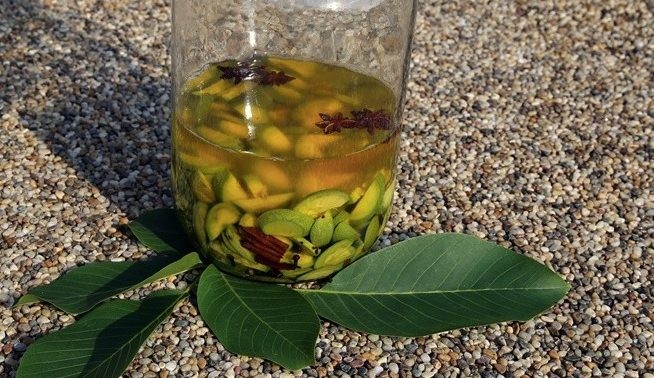
Steep 10-12 tablespoons of dried walnut leaves in 1 liter of cold-pressed vegetable oil and let it infuse for a whole month – don’t forget to shake it from time to time. Rub the oil prepared and filtered this way into the skin. The oil is also excellent for warm compresses for rheumatism – apply warmed oil, wrap and leave to act overnight. Warmed oil is also excellent as a medicinal compress for bronchial conditions and cough.
Recipe: tea from walnut leaves
You need: 0,5 KL of dried and ground walnut leaves, 2,5 deciliters of water.
Put the walnut leaves and the water into a small pot and boil this mixture for 4 – 5 minutes. Then let it cool naturally. Drink this tea during acute problems 1 – 2 times a day.
Recipe: walnut leaf decoction
This decoction can be used on various skin injuries or areas affected by some skin disease. It accelerates healing and disinfects wounds.
You need: 1 teaspoon of dried walnut leaves, 3 deciliters of water.
Pour boiling water over the walnut leaves and let them steep covered for 30 minutes. Then you can apply this decoction on a cotton pad or on gauze to a clean and dry wound, or to areas with a skin disease.
How else to use walnut leaves
Preparation of an infusion for tired eyes and eye inflammation
Boil dried walnut leaves for two minutes in boiling water and let them steep for another 20 minutes. After cooling, strain the infusion through a clean cloth. Dip gauze squares into the infusion and apply them to closed eyelids for approximately 10-20 minutes. Repeat this several times a day using the same infusion, which you slightly reheat each time.
Walnut extract
Pour half a liter of alcohol over one hundred grams of crushed fresh green husks or walnut leaves and 5 grams of finely chopped almonds. Let steep at room temperature for 2 – 3 weeks, shaking occasionally. Drink one small glass daily on an empty stomach, preferably in the morning, to improve digestion, for mucus in the intestines, parasites or as a healthy aperitif.
For the bath
Soak the chopped walnut leaves, place them in a container, pour boiling water over them, cover with a lid and let steep at room temperature for 15 minutes. Strain the finished infusion through a fine sieve or through gauze. It is used for washing or as an additive to a bath. It helps with inflammations.