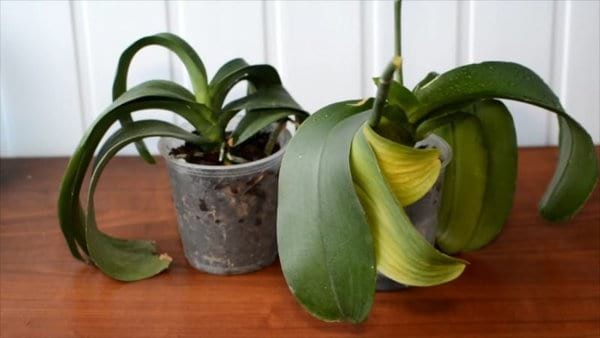
Article content
Why are your orchid’s leaves drying out? In this article we will answer that question for you and help you revive your plant. The orchid has always been, and of course still remains, one of the most popular plants among many fans of growing houseplants. It is therefore especially painful to watch how the orchid’s beautiful flowers begin to lose their former color and how its leaves wilt, dry out, yellow and die. So why does this happen? Why does the orchid dry out and lose its charm? Let’s look at the most common mistakes in the practice of growing this beautiful flower.
How to prevent this from happening?
First, it is necessary to determine the correct reason why your orchid’s leaves are withering. Let’s first look at the simplest and most natural process. If it happens that only the lower leaves of your orchid dry up or turn yellow while the remaining ones stay juicy green, full of moisture and remain thick, simply remove those old leaves so that new ones can grow in their place in the future. Don’t rush to remove the old leaves; they may still contain plant nutrients that the flower needs. When the right time comes, the plant will drop them on its own. A completely different situation arises when all of an orchid’s leaves dry up completely. They dry out, turn yellow, look as if they are hollow inside and are no longer as thick as before. There can be several reasons.
- The orchid is not in a suitable environment
- The room is hotter than 25 degrees
- The air in the room is excessively dry
- The orchid has an overgrown root system
Reviving the plant, if one of the above is the problem, will be very easy. Simply move the plant to a more humid and cooler location. Water it lightly and regularly mist it with water from a spray bottle. If the plant has been in this condition for a longer time, with its leaves yellowing slowly and gradually, some negative processes have probably already occurred. More precisely, the orchid may have begun to dry out or, conversely, to rot. In such a case you must repot the plant, preferably into a pot with fresh bark, and carefully inspect its root system. If you see that some flowers are completely rotten or dry, cut them with a knife and sprinkle with cinnamon. But if there is even a small living spot on a rotten root, you should not cut off that root. These roots still supply the plant with the necessary nutrients.
Another reason for limp leaves
This can be caused by an overgrown root system. An orchid should be repotted every 2-3 years. When you see that its roots are protruding beyond the edge of the pot, it is undoubtedly a sign that it needs repotting. If you then regularly mist the plant with water and water it sufficiently, but of course not excessively, this will help the plant revive and over time it will delight you again with its beautiful and fresh flowers.