Article content
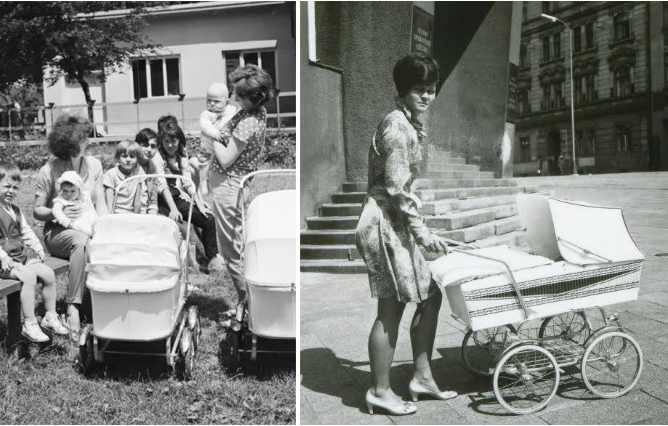
During socialism, mothers wished for beautiful and modern strollers, but their options were often limited. Let’s recall what the strollers that even Husák’s children were pushed in looked like.
Stroller production under socialism
After the Victorious February of 1948, manufacturing processes began to change, including those for baby strollers. All stroller production was concentrated in the Mělník company Liberta, which in the 1950s introduced the so-called “kukaně” – low, wide prams. Later came the well-known eight-spring prams, which were characterized by a boxy shape. From 1963, foldable bassinets began to be produced in Mělník, a novelty that made life easier for many mothers.
“In the old photos where I am small in a stroller, you can see my mom and dad standing proudly by a white bassinet on small wheels,” recalls Ivana Sýkorová from Karlovy Vary.
Practical innovations and aesthetic changes
In the second half of the 1960s, strollers gradually increased in height. This trend had a practical reason – with the growing number of cars, exhaust fumes increased, and higher strollers were meant to protect babies from harmful substances.
In the 1970s, during the normalization era, strollers began to be produced in colorful designs. Yellow, red, green and blue strollers became common. Although they were very similar in design, they mainly differed in color schemes.
The desire for foreign brands
Czechoslovak mothers, however, also dreamed of other models, mainly of luxury strollers by Stegner or Zekiwa from the GDR. These strollers, sometimes equipped with wicker baskets, were available for 400–500 East German marks, which amounted to approximately 1,200–1,500 Kčs. Ivana Sýkorová recalls that she pushed her daughter in a Zekiwa stroller, which she later sold for 1,000 Kčs, thus recouping part of the investment.
For comparison – a new stroller by Liberta cost around 700 Kčs at the time (washable surface) or 900 Kčs (corduroy version).
The 1980s and strollers with little windows
In the 1980s, strollers with little windows, which could be bought at Tuzex or second-hand, were very popular. Their price, however, was high, around 2,000 Kčs, even though they were used strollers. At this time, three-in-one sets also began to appear – a deep stroller, a sports stroller and a car seat bag. These were, however, heavy and often impractical, which led many mothers to prefer lightweight folding umbrella strollers. Umbrella strollers with small wheels were tippy, but their main advantage was easy portability and compactness.
Parents’ creativity in times of shortage
The socialist era also brought shortages of children’s accessories, so many parents used their creativity. Pram bedding was often hand-embroidered, sewn from kanafas or knitted or crocheted from wool. Although various toys could be bought in stores, accessories and quality equipment often depended on mothers and their skills.
Conclusion
The history of strollers goes far back. The first serial production began in 1840, when the British industrialist Lewenson started stroller production. In Czech lands, socialist strollers had their uniqueness – whether it was the colorful Libertas or luxurious foreign models, every generation of mothers remembers theirs.
Modern strollers today are incomparably more comfortable, but memories of those socialist ones carry a dose of nostalgia.