Article content
Clever and almost magical tricks have been shown and passed down by people since time immemorial. Tricks of all kinds still entertain audiences today. Whether it’s a magician’s performance in the circus, or an amateur act by a party attendee. Do you want to learn an effective and at the same time easily explainable trick?
Easier than it seems
For this physics experiment, which is also a very popular trick, you will need:
- Tealight candle
- Matches
- A taller glass vessel (glass, measuring cylinder)
- A plate or shallow dish
- Water
- Food coloring
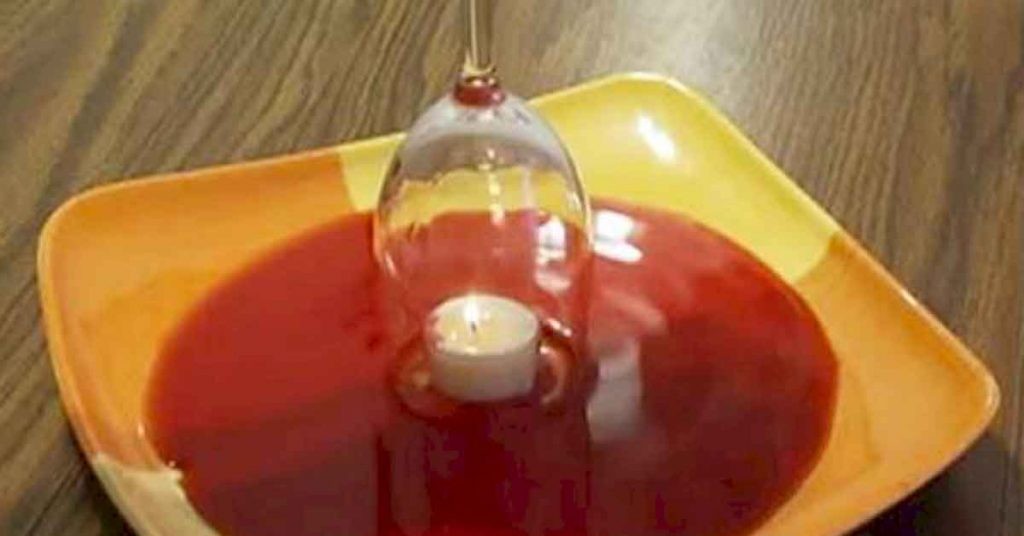
To increase the effect of this „trick“ we color the water with food coloring. Then pour water onto the bottom of the plate/dish and place a lit tealight candle in the middle. We then cover it with a glass, upside down. At first we’ll see bubbles escaping from under the glass. Then the candle will slowly go out, and at the same moment we’ll see the water level in the glass rise.
Physical principle
The cornerstone of this trick is the creation of a partial vacuum. After covering, the candle flame begins to heat the air inside the vessel, and it starts to expand, which is why bubbles escape at first. Inside the glass oxygen combines with hydrocarbons, producing vapor and carbon dioxide. However, the flame needs oxygen to burn, which is depleted in the glass, so it dies down. Temperature and pressure drop. The difference between the low pressure in the glass and the higher atmospheric pressure causes the air to push water from the plate/dish into the glass. This equalizes the pressures.
You can achieve a similar effect with another experiment based on the same principles, using a balloon, a glass bottle and hot water. It is enough to stretch the balloon over the neck of a bottle which we pour with hot water. The air inside the bottle increases in volume and begins to fill the balloon as well. If you then pour cold water over the bottle, the balloon will show how the air behaved in the bottle in the previous experiment.