
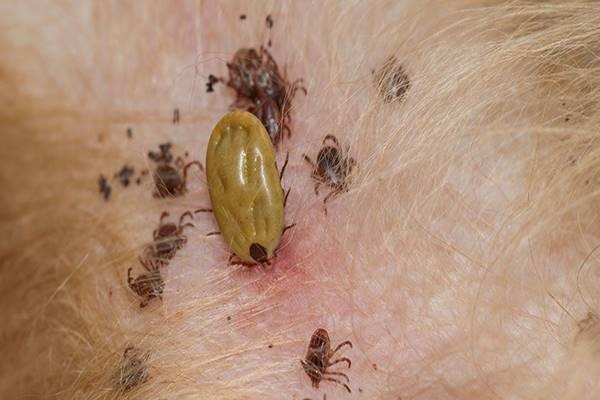
Article content
The tick season in Central Europe begins around mid-March, of course depending on the weather and temperatures, but with the start of spring people and animals are already at risk, so caution is in order on walks in nature and in city parks. Furthermore, a whole range of misconceptions about ticks or their removal circulates among people. Are you also falling for these myths? Better read the experts’ advice!
Ticks fall from trees
A common myth is linked to walks in the forest and finding a tick embedded in the skin of the scalp, neck or upper part of the body. According to experts, ticks do not climb trees; they usually do not get higher than 1 meter above the ground and occur in forest undergrowth—ideally impenetrable and dense—where the air humidity is higher.
After being bitten it is necessary to disinfect the wound or apply an ointment
Most people try to disinfect the wound after pulling out a tick or smear it with an ointment to prevent inflammation. That is unnecessary and these practices can even do more harm. The tick releases serum directly into the capillaries from the start of feeding, so a disinfectant will only cause irritation but will not kill pathogens. In the case of anti-inflammatory ointments there can even be a reaction of the Lyme borreliosis bacteria due to the steroid contained, making the condition worse.
Testing all ticks
Patients often request testing the tick for Lyme disease infection; according to experts this does not make sense, because potentially all can be infectious, but only in about 2% of cases does the disease develop in a person after a bite. After a positive finding in the tick, patients would demand antibiotic treatment without a substantiated positive blood test. For this reason ticks are generally not tested and you can dispose of it after removal.
The tick must be removed intact without residue
Of course it is necessary to remove the tick whole, but it can happen that it breaks during removal and the mouthparts remain in the skin, which can provoke an inflammatory reaction. That can be mistakenly interpreted as Lyme disease. It is better not to try to pick out remnants of the tick so as not to spread infection. Lyme disease can only be proven by a blood test.
Removing a tick with cream, oil, vinegar or matches
During tick season many tips appear on how to easily and quickly remove a tick. Forget these tips; according to experts a good pair of tweezers and a quick pull are sufficient to remove it without damaging the surrounding skin. Any twisting, suffocating or treating with cream or vinegar only increases the risk of infection, because the tick will emit serum when squeezed. You can also try the technique of removal using thread.
Redness after removal means infection
This view is widespread, but redness does not automatically mean infection. The appearance of redness or a welt after removing a tick is only the skin’s reaction to a foreign body, especially to remnants of mouthparts or microscopic barbs. It will heal after a few days. Infection can even occur without detecting the tick. In children a tick can attach and then drop off after feeding; moreover, larvae are almost invisible to the naked eye and can be overlooked at the time of attachment.
There is no risk of infection if removed quickly
This view was mistakenly spread before, but infection does not only occur after 24 hours as is commonly believed. Infection can occur even with an attached tick within a 1–2 hour timeframe. Experts explain this by the fact that infection of the wound can occur during removal. In any case, do not delay and remove the tick immediately when you find it on the skin.
Vaccination protects me
Do not fall for this common myth: vaccination concerns tick-borne encephalitis, not Lyme disease. Lyme disease is completely curable, but some patients require retreatment with antibiotics. Conversely, ticks do not spread tetanus, which is another common belief doctors encounter, nor does Lyme disease generally threaten pregnancy. That occurs only in very rare and poorly treated cases.


