Article content
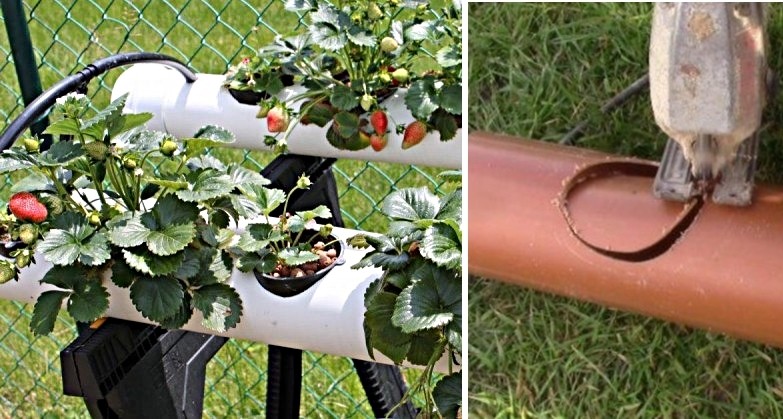
If you want to devote yourself to cultivating strawberries on a large scale but don’t have enough space for it in the greenhouse, you’ll definitely be interested in the idea of a clever DIY gardener. A horizontal structure made of PVC pipes reduces the area on which strawberries can be grown without losing productivity. It takes up almost no space and is easily movable, which means you can easily relocate the strawberries to a new site if their current one doesn’t suit them.
You will need two pipe diameters
You will need sewer PVC pipes with a diameter of 15 cm, as well as PVC pipes with a diameter of 3–4 cm and end caps — two end caps for each of the pipes. A piece of hose for water drainage, a pump with a timer for automatic watering, expanded clay (ceramsite), a drill and a saw will also come in handy, and possibly other tools at your discretion.
Before you start making the structure, plan its shape and size. Choose a sunny location; you can also fasten the pipes to a fence. If you decide to create a really large complex, you will need support for the pipes. It should be strong enough, because a two-meter pipe filled with soil can weigh up to 25 cm. The structure can be shaped like a pyramid or simple forks.
Thread the thinner pipe through the wider one
First cut several holes with a diameter of 10–15 cm in the wider pipe at 15 cm intervals. Drill several smaller holes along the length of the thin pipe. Wrap it in geotextile and secure it with wire so it doesn’t fall out. Drill a hole in the end caps the same size as the diameter of the thinner pipe. Pour about 2 cm of soil into the bottom of the wider pipe. Then thread the thinner pipe through the holes and fill with soil.
Connect a hose with a timer to the thin pipe and put a hose for draining excess liquid on the other side. This will ensure regular and proper watering. If you want to save part of the costs, you don’t have to install the internal piping for irrigation, but it will save you a lot of work that you would have with manual watering. You can replace the end caps with wooden plugs.
Plant the strawberries and place them in a sunny spot
When everything is ready, dig small holes in the soil, soak the strawberry seedlings for several hours in a root stimulant, and then plant them. Water newly planted strawberries once a day and lightly shade them from direct sunlight during the first week. Strawberries grown in pipes have a number of advantages. They are not suppressed by weeds and are reliably protected against pests crawling on the ground. In addition, they save you a lot of space and the strawberries then produce cleaner fruit, because the fruits do not touch the ground.
On the other hand, the soil in the pipes dries out and becomes depleted more quickly. Therefore, fertilize them every two weeks with a solution of a complex fertilizer and at the first signs of disease remove the affected bush and the soil beneath it. With the coming low temperatures wrap the strawberries in 2–3 layers of textile film. The first season of such cultivation is usually not the strongest, but yields increase in subsequent years.