
Article content
At this moment, as you are reading these lines, you are probably sitting. It’s okay to sit for a few minutes, but the longer you sit, the more restless your body becomes. You sit… resting for minutes before you can get up and go for a walk.
That may sound funny. Our bodies like to sit, right? Not quite.
Sure, a short period of sitting helps us recover from stress or rest after exercise. With today’s lifestyle we sit much more than we move, and our body isn’t built for such a sedentary way of life. In fact, it’s quite the opposite.
The body needs regular movement
The human body is made to move, and its structure itself is proof of that:
- Our body contains more than 360 joints and approximately 700 skeletal muscles that allow easy and fluid movement.
- The unique structure of the body allows us to stand upright against gravity.
- Blood must move in order to circulate properly.
- Movement benefits our nerve cells; our skin is elastic and adapts to our movements.
- So if every centimeter of the body is ready and waiting for us to move, what happens when we simply don’t move?
- Let’s start with the spine of the problem, literally! The spine is an elongated structure of bones and cartilaginous discs that press against each other.
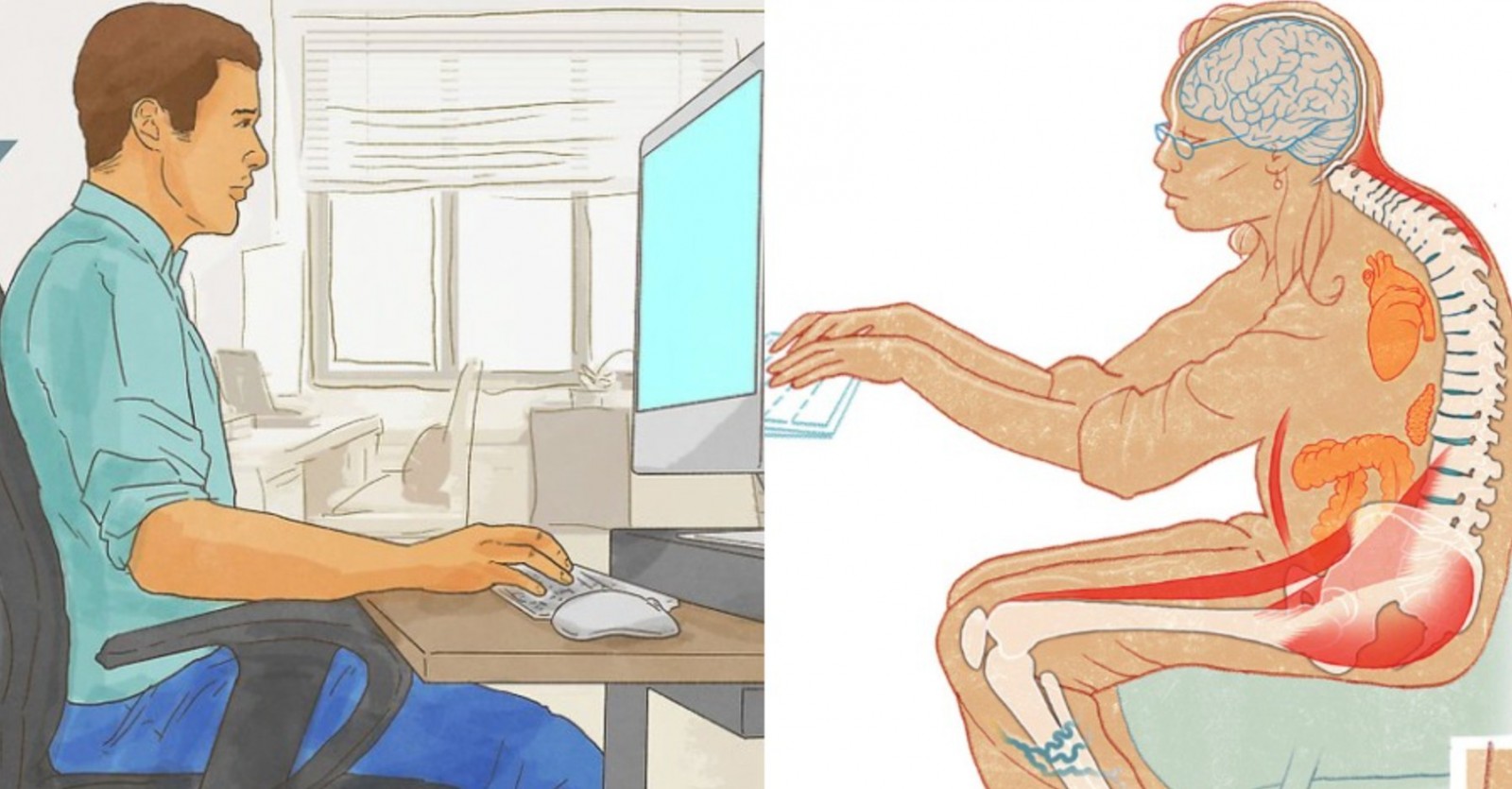
The joints, muscles, and ligaments attached to the bones keep it in an upright position. We often sit with rounded backs and hunched shoulders, a posture that unevenly loads the spine.
Over time this leads to wear of the spinal discs, overloading of certain ligaments and joints, and pressure on muscles that stretch to adapt to the curved position of the spine.
Breathing problems
This hump also reduces the chest cavity when sitting, so the lungs have less space when breathing. This is a problem because it temporarily limits the amount of oxygen that reaches the lungs and the bloodstream.
Muscles, nerves, arteries and veins surround the skeleton, forming layers of soft tissues in the body. Sitting itself crushes, compresses, and squashes these more delicate tissues, which are exposed to high pressure.
Have you ever experienced numbness and swelling of the limbs while sitting?
In the most compressed areas, nerves, arteries and veins can become blocked, which limits nerve signals, causes numbness and reduces blood flow to the limbs, causing swelling. Sitting for too long also deactivates lipoprotein lipase, a special enzyme in the walls of blood capillaries that breaks down fats in the blood. When you sit, you don’t burn fats as well as when you move.
What effects does this posture have on the brain?
Most of the time you can sit and use your brain. However, if you sit for a long time, it has exactly the opposite effect. When you don’t move, blood flow and the amount of oxygen reaching the bloodstream through the lungs decreases. Your brain needs these two things to stay alert. So it’s likely that your concentration will decrease because brain activity slows down.
Negative effects
Unfortunately, the negative effects of a sedentary lifestyle do not only appear in the short term.
Studies have shown that long-term sitting is associated with certain types of cancer and heart disease and may contribute to the development of diabetes, kidney and liver problems.
Scientists have found that physical inactivity is responsible worldwide for approximately 9% of premature deaths annually. That’s more than 5 million people. A seemingly harmless habit can change our health.
Fortunately, the solution to this growing threat is simple
If you have no choice but to sit for hours (e.g., due to work), at least try to change your slouch. Keep your spine straight, and when you don’t have to sit, try to move more and maybe set a reminder every half hour to stand up. Most importantly, realize that our body is made for movement, not for rest.
And now that you’ve read this far, why not stretch now? Give your body a short walk. It will thank you later…
Source: Iatropedia.gr


