Article content
According to reports, scientists have managed to create an image of the human face of the future and now we know how our species will likely look in the near future.
The face of humanity
But how much has our face changed since humans first appeared on Earth?
„The face“ of humanity has changed considerably over the last two million years. But this change has not stopped.
According to researchers, our face is still in the process of transformation and will continue to evolve to better respond to new needs.
Scientists believe that while some facial features will remain the same, others will have to adapt and evolve to a new reality and future conditions.
We are the most expressive species on Earth
Facial expressions have changed and have become more harmonious instead of intimidating, to get along with others and live together.
The human face has further evolved, making us the most expressive species on Earth.
However, the question that bothers experts is: what will the faces of the future look like?
According to international experts, there are already some clues to solving the mystery.
Will we have a bigger brain?
One of the major changes is directly related to brain size and its own evolution, which has allowed us to have greater capabilities, because we are social, cooperative beings and we need these traits.
As in the old dilemma before; the egg or the chicken, it is not exactly known whether we are expressive because we have a brain that allows it, or whether our brain was better equipped because of our expressiveness.
The fact that faces are so familiar to people — because anyone who sees a face recognizes it — does not actually mean that this is a characteristic that predominates in nature.
According to Penny Spikins, a Paleolithic archaeologist from York University, „we have our eyes very close together and, moreover, human dental arches are disproportionately small compared to the rest of the body and we have smaller teeth. This means that the physical characteristics of our face have an unusual nature,“
What you eat will shape your face
David Perrett, a researcher at the University of Saint Andrews and author of the book „In Your Face: The New Science of Human Attraction“, explains that diet is constantly changing and this also affects the shape of the face.
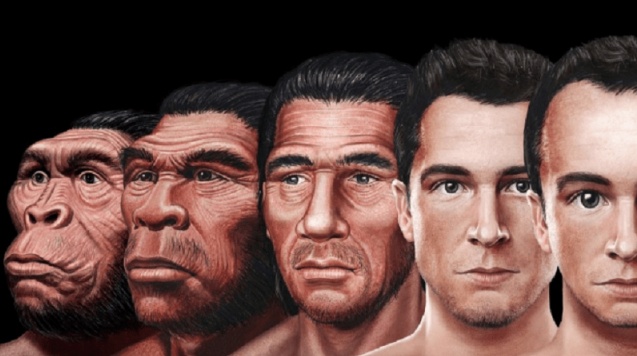
Our faces have changed a lot from the common ancestor we shared with chimpanzees about 6 to 7 million years ago.
Key indicators include a reduced brow ridge, a flattened forehead, a less pronounced muzzle and chin.
Our earliest ancestors were the opposite of this description: a prominent brow, a pronounced muzzle, and a strong chin.
“The basic form of the human face appeared about two million years ago and changes since then have emphasized a gradual reduction of features,” said Erik Trinkaus, a professor in the Department of Anthropology at Washington University.
Forever young?
If the human skull continues to evolve, scientists expect it to become juvenilized in terms of cranial dimensions, which will lead to a smaller face with proportionally larger eye sockets, a smaller chin, and a rounder, more developed cranial vault.
This could be expected if there were a process known as „neoteny“, which means that people would actually retain their youthful appearance after reaching adulthood.
A smaller face, a larger skull — the face of the future?
Photographs of what we will look like according to scientists
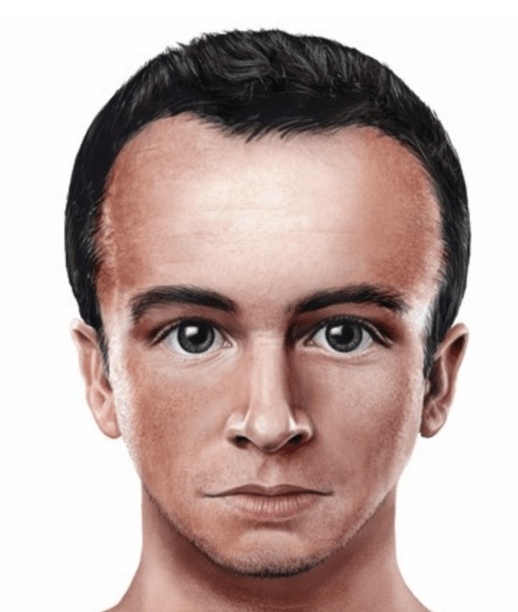
In other words, the human of the future, experts say, will probably have a smaller face and a larger skull than people today.
However, for this evolution to occur, scientists say a change in the female pelvis is necessary, as the birth canal is already extremely narrow, and therefore many children are born prematurely and must reach maturity postnatally with certain limitations.