Article content
Myofascial pain syndrome manifests as chronic pain caused by repeated muscle contractions and the compression of trigger points.
A tennis ball has rubber elasticity, which helps release and stretch muscles and soothes pain.
We provide instructions on how to use a tennis ball to relieve pain in different parts of the body:
1. Tense neck
The spinal erectors and suboccipital muscles need to relax after long periods spent in the office. The following exercises can help soothe neck pain:
Lie on the floor face up and place 2 tennis balls under your head. Begin moving your head so that the balls remain comfortably positioned at the back of the neck.
Stay in this position for 1 minute, then turn your head from one side to the other.
2. Back pain
Back pain is often the result of uncomfortable shoes, improper sleeping positions, or incorrect sitting posture.
Here is a guide on how to reduce this pain:
Place 2 tennis balls under your back, between the tailbone and the ribs. Move your pelvis from side to side while keeping the balls positioned under your back.
Slow down the movements in the tense area of the back and reduce pressure near the spine. Breathe deeply and repeat for 5 minutes.
3. Stiff shoulders
This exercise stretches and relaxes the rotator cuff muscles and relieves shoulder pain that arises from poor posture or lifting heavy objects.
Lie on the floor face up. Place 2 tennis balls behind your shoulders and roll them.
4. Painful hips
If you wear uncomfortable shoes, sit for long periods, or put strong pressure on your hips, you may experience pain in both small and large muscles that affect your pelvis, such as the piriformis, the gluteus maximus, and the gluteus medius.
Here is how to reduce this tension:
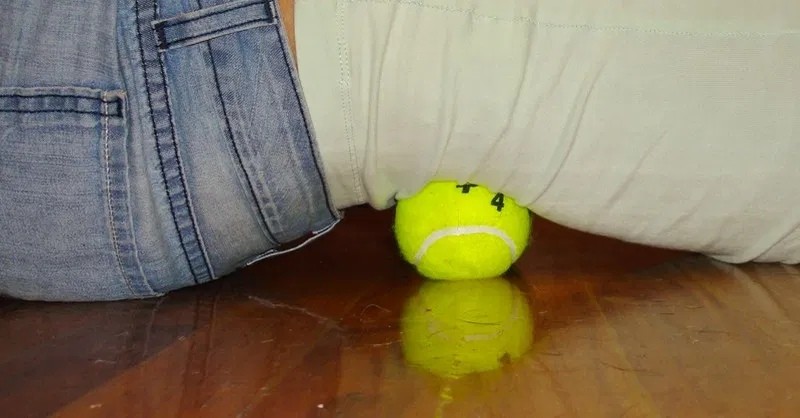
In a lying position, place a tennis ball between your hip and the floor and lean on it. Make 12 slow circular movements and then switch sides.
5. Compressed chest
Daily activities like prolonged sitting, cooking, using a computer, or talking on the phone can lead to a tight chest.
This problem can worsen and cause breathing difficulties and nervous system issues.
Here is a guide on how to treat this problem:
Stand facing a corner or a doorframe and place a tennis ball under your collarbone. Breathe deeply and stay in this position for one minute.
Begin moving the ball from the collarbone up and down, from one side to the other. To increase muscle mobility, start moving your shoulders and neck for one minute, then switch sides.
6. Knee pain
While gardening or doing work around the house, you can easily strain the joint capsule in the knee.
Exercises with a tennis ball can help release the muscles between the kneecap, the shin, and the thigh.
Sit on a chair, bend your knees and place a tennis ball on the back of the knee. Repeat this 10 times and rest for 10 minutes.
7. Poor posture
Poor posture can seriously damage the spinal muscles and lead to breathing problems. For this reason, lie on the floor, place 2 tennis balls along the sides of your back, and put your hands behind your head.
Draw your head towards your chest and lift your hips. Breathe deeply. Roll the tennis balls across your back for 4 minutes.
8. Hand pain
Prolonged typing can tighten the wrist flexor.
Place your hand on the table on top of a tennis ball. Place your other hand on top of the first and apply enough pressure. Move the tennis ball horizontally toward the palm and back.
Do this exercise for 3 minutes and repeat with the other hand.
9. Sore feet
Prolonged standing or wearing uncomfortable shoes can lead to foot pain, as well as plantar fasciitis and pain in the upper part of the spine.
Exercises with a tennis ball will help stretch your feet and support their flexibility. Place a tennis ball under your foot and stand on it. Roll it up and down toward the heel.
Repeat this exercise for 1 minute on each foot.
10. Painful thighs
Tennis balls relieve pressure in the quadriceps and the vastus lateralis.
Sit on a chair and place tennis balls under your thigh. Gently straighten and bend the knee 40 times. Move your thighs horizontally, rolling the ball along the side of the thigh.
Then do the same on the other side.