Article content
The 1980s were for many of us a time full of unique school experiences. Compared to today’s school systems many things were different, but some habits and rules remain in memory as a nostalgic reminder of the past. In this article we will look at the 20 most striking differences between school life in the 1980s and today.
1. Saturday classes
In the early 1980s it was common to go to school every other Saturday. In some schools lessons were held in the morning and the afternoon, which meant that weekends were partly dedicated to school duties.
2. Wearing the smock
The blue smock was a mandatory part of the school uniform. If someone forgot their smock at home, they were immediately written into the inspector’s register. Some students tried to make the smock more pleasant, for example by wearing a sweater over it.
3. Compulsory Russian language lessons
Until the mid-1980s, Russian language instruction was compulsory. It was a language every student had to learn, which was often a source of collective resistance among pupils.
4. School calendar and holidays
During the socialist period the school calendar differed from today’s. Some holidays that were observed then no longer exist in the school year today, and conversely events that contradicted the system could not be held.
5. District schools
Everyone attended district schools, with no room for choice or selectiveness. The school was assigned based on place of residence.
6. State emblem on the board
The state emblem of the Hungarian People’s Republic was placed above the blackboard in every classroom as a symbol of the Kádár era.
7. Overhead projectors
The leading classroom technology were overhead projectors, which helped teachers bring lessons to life. Computers and digital devices were still in their infancy.
8. Recesses and TV shows
School breaks were often devoted to discussions about television shows watched by the whole country. Shared TV programs, such as „Seasons of Whimsical“ or „Neighbours“, were popular topics.
9. The canteen and favorite food
School canteens had their favorite dishes. A sponge cake square with chocolate icing was one of the most loved meals, which many recall with nostalgia.
10. Rules we only laugh at today
School rules could be peculiar – for example the obligation to run around the park during a twenty-minute break in a nylon smock. These rules may seem bizarre today, but at the time they were part of everyday life.
11. School gate and security
School gates were open, and it was possible to enter the school freely. There was no security staff or modern safety measures that are standard today.
12. Walking home alone, without parents
Children walked home from school by themselves, which would be almost unimaginable today. Everyone was responsible for their own route.
13. Vending machines and specials
Near schools there were vending machines where children could buy Donald chewing gum or Star Wars stickers. This option was very popular.
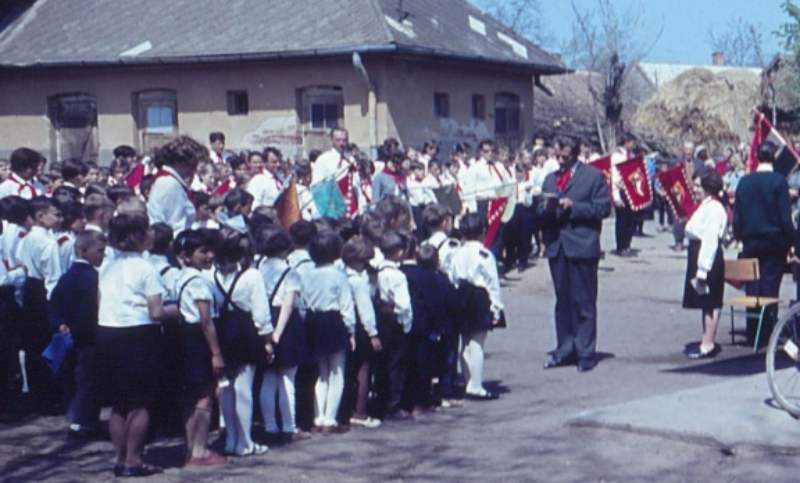
14. The pioneers and drummers movement
The pioneers and drummers movement was still active. In some schools students were expected to wear a blue or red tie and perform ceremonial duties.
15. Savings stamps and “Fillér will change to HUF”
Savings stamps were commonly used, and children could buy stamps for small amounts that could be redeemed at the end of the year.
16. Paper collection and other school tasks
School paper collection was a serious competition and pupils tried to ensure their class won. Children often went to collect paper even from other people’s apartments.
17. Camp experiences and summers
Camps were an important part of school life. Children began the camp season with assembly, flag raising and morning exercises, and spent the whole summer talking about these experiences.
18. Absence of mobile phones
Mobile phones did not exist, and planning meetings was done on paper. Meetups in town were organized without modern technologies.
19. Collective upbringing and outsiders
Collective upbringing was common practice, and outsiders could have a say in the upbringing of children at school and in the community. Respect for elders was part of everyday life.
20. Respect for teachers
Teachers were respected and talking back was not acceptable. School discipline was strict and parents did not dare to confront teachers.
Although school life in the 1980s differed significantly from today’s modern schooling, these memories remind us of unique and nostalgic moments. While rules and technologies change, some values and memories remain alive.